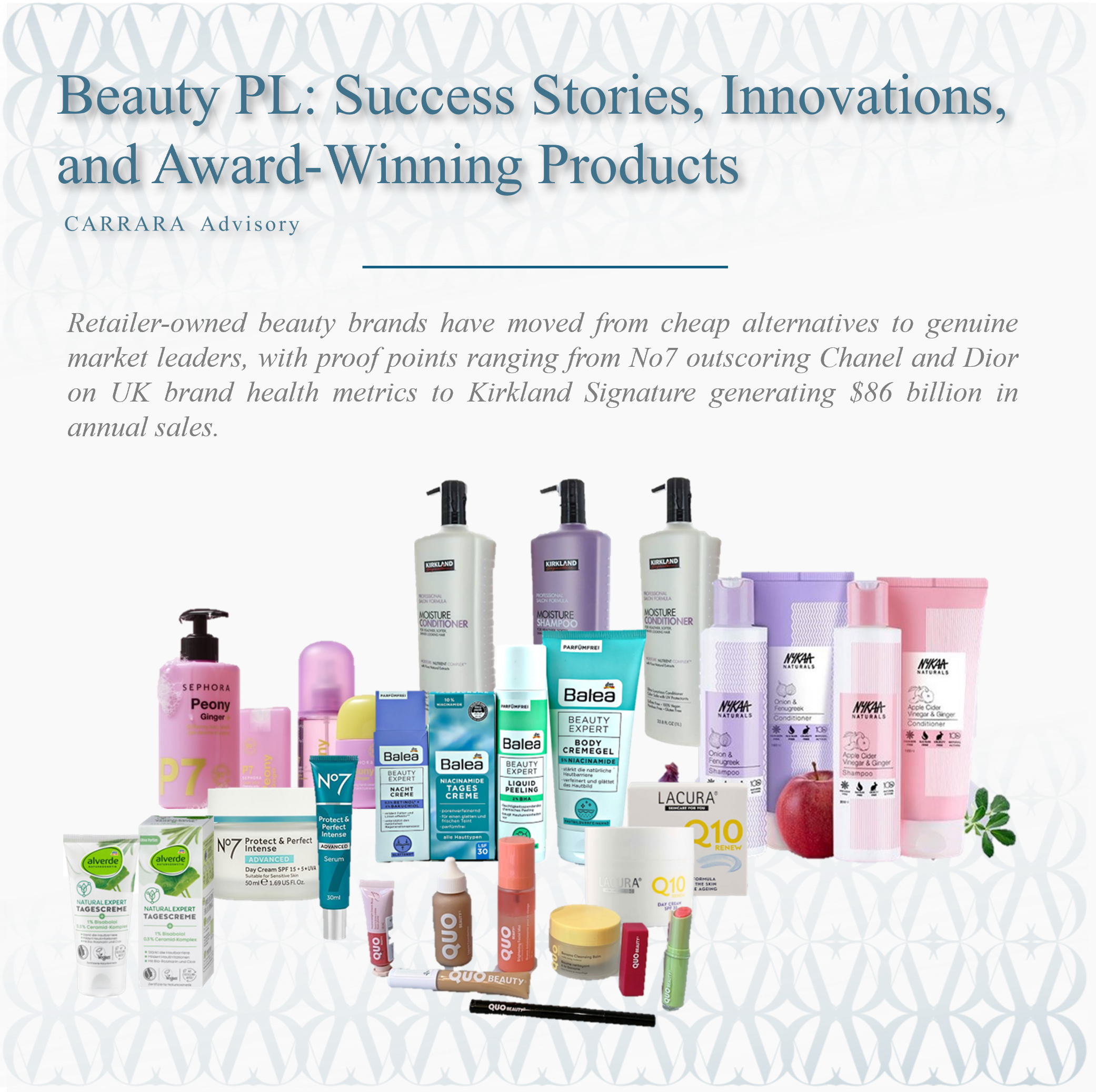
Beauty Private Label Beauty: Success Stories, Innovations, and Award-Winning Products
The strategic case for retailer private labels in beauty is made in full in our companion piece, "The Strategic Reinvention of Private Label in Beauty and Wellness." What follows is the evidence behind it — the specific stories of brands that overcame consumer skepticism, earned independent validation, and built the kind of loyalty that puts them in direct competition with national brands whose marketing budgets are orders of magnitude larger.
No7: Science Validates a Pharmacy Brand
Founded in 1935, No7 spent its first seven decades as a reliable but unremarkable pharmacy staple. The first major inflection point arrived in 2007, when an independent BBC Horizon documentary evaluated whether any over-the-counter anti-aging product could genuinely perform on par with prescription-grade treatments for photoaged skin. The University of Manchester research team involved found No7 Protect & Perfect to be unexpectedly effective.
What followed was one of the most dramatic retail events in modern UK beauty history. Daily sales of the serum surged by close to 2,000 percent in the immediate aftermath of the broadcast. Boots sold through its entire annual production allocation in under two weeks and ran manufacturing operations continuously to try to meet demand. This was not a viral marketing campaign. It was an unsolicited scientific endorsement by a credible independent institution, and the trust it created for the No7 brand proved durable across subsequent product generations.
The University of Manchester collaboration that underpinned Protect & Perfect was renewed and deepened over the following two decades. Its most consequential output to date arrived in April 2023 with the launch of No7 Future Renew — a range built around a novel peptide complex identified through an AI-assisted research process that mapped which peptides occur naturally in skin and can realistically penetrate to the dermal layers where cellular repair happens. The development involved more than 4,200 participants across two clinical trials and 23 user studies, and a blinded split-face trial demonstrated measurable reversal of multiple visible signs of skin damage in 97 percent of participants. Patent filings have been submitted for both the peptide combination and its delivery mechanism.
Commercially, Future Renew became the largest single beauty product launch in UK retail history, surpassing 500,000 purchase transactions in its first month. Twelve months after launch, the serum was still selling at a rate of roughly one unit every seven seconds. The brand's market position has consolidated accordingly. YouGov BrandIndex data for 2024 places No7 first among all skincare brands in the UK on a composite index measuring impression, quality, value, satisfaction, and recommendation — ahead of Clinique, Chanel, and Dior. The value dimension is where the private label dynamic is most visible: No7 led the market with a value score of 21.9, while Chanel recorded a negative value score of 6.3. A pharmacy own-brand is leading on the brand health metrics where luxury houses cannot compete.
Balea: A German Drugstore Brand Goes Internationally Viral
dm-drogerie markt's Balea is one of the best-performing private label beauty brands in the world by most commercial measures, yet it remains largely unknown outside the markets where dm operates. Launched in 1995, the brand began as a straightforward personal care range. It has since grown into a skincare staple available across 13 European countries and, as of 2019, in South Korea — a market where consumers have historically been among the most discerning in the world when it comes to skincare formulation.
The commercial context is striking. In dm's 2023/24 financial year, own-brand products accounted for 53 percent of total German sales of €12.74 billion — meaning more than half of every euro spent in a dm store went to a product dm itself owns. It is important to note that this 53 percent spans dm's entire assortment, which extends well beyond beauty: household cleaning (Denkmit), baby and childcare (Babylove), organic food (dmBio, which alone exceeded €1 billion in sales in 2024/25), vitamins and supplements (Mivolis), and oral care, among others. Beauty and personal care — where Balea and alverde sit — represents roughly 25 to 30 percent of dm's total sales mix, meaning the beauty-specific private label contribution is a meaningful but considerably smaller slice of that headline figure. By 2024/25, dm's German market share had reached an estimated 27.5 percent in value terms (NielsenIQ), a position the company attributes in part to the performance credibility of its private label range. In an independent German retail survey conducted by ServiceBarometer AG, dm's own brands received the highest price-performance rating of any major chain in the country.
What Balea has achieved that most private labels have not is the transition from value substitute to genuine preference brand. Consumers who choose it over national brand alternatives in independent evaluations do so not primarily because of price but because they consider the product superior. More recently, this dynamic has crossed dm's traditional European footprint: the brand has become a point of reference in the so-called "D-Beauty" conversation on social media, with content creators in the US and Asia using it as a benchmark for affordable efficacy in the same way K-beauty products once occupied that position.
Aldi Lacura: When Blind Tests Are the Marketing Strategy
Aldi's Lacura range has built its reputation almost entirely through independent product testing, making it a structurally unusual success story in an industry where marketing investment typically precedes consumer trust.
The brand has accumulated a consistent record in European blind-test evaluations against competitors priced considerably higher. In testing involving 2,000 volunteers, the Lacura Q10 anti-wrinkle day cream was ranked first for anti-aging performance against more expensive rivals. In a separate UK evaluation in 2010, a Lacura intensive serum was named the top product in its category, outranking more established brands. Each time results of this kind were made public, the market response was immediate: on one occasion, a UK newspaper report on a Lacura test win prompted consumers to purchase more than 35,000 units of a single product in a single day.
The current Lacura lineup extends well beyond its original Q10 positioning and now includes glycolic acid treatments, vitamin C serums, peptide moisturizers, and intensive eye creams — formulations that closely track ingredient categories driving growth in the prestige beauty segment, priced at a fraction of the cost. Aldi's full premium Lacura skincare collection in the UK, comprising five products, can be purchased for approximately £27, compared to more than £250 for the combined equivalent from prestige reference brands.
The strategic lesson is clear: a private label that invests in genuine formulation quality and submits to independent evaluation accesses a form of third-party endorsement that is functionally more credible than most advertising, at a fraction of the cost.
Sephora Collection: Private Label at the Center of the World's Largest Beauty Retailer
Sephora's 2024 financial results were the strongest in its history. LVMH's leadership publicly noted that the retailer's revenues have expanded by more than tenfold since the group's acquisition in 1998 and framed it as evidence that beauty functions as an accessible luxury even when broader consumer spending softens.
The Sephora Collection sits at the center of this performance. The own-brand range — comprising more than 700 SKUs across makeup, skincare, haircare, fragrance, and body care — played a meaningful role in the retailer's global expansion narrative in 2024, offering quality-oriented consumers a proprietary alternative to prestige brands at substantially lower price points. The Collection is certified cruelty-free and aligned with Sephora's Clean at Sephora ingredient standards, which positions it favorably with the clean beauty consumer segment that has driven disproportionate growth in specialty beauty retail.
The brand's influence extends beyond its direct sales contribution. Traackr's Brand Vitality Score for 2024, which evaluates beauty brands on visibility, engagement, and trust through creator and influencer content, ranked Sephora as the top US beauty brand — with a score approximately twice that of the next four brands combined. This is a measure of brand authority, not merely retail reach. Sephora Collection participates in building that authority by giving the retailer a product stake in the conversation rather than simply a distribution role.
The Collection's in-store merchandising reinforces its brand-building intent. Sephora allocates dedicated fixtures to its own range, and its semi-annual promotional events offer the deepest discount tier — 30 percent — exclusively on Sephora Collection products, using price as a mechanism to accelerate trial among consumers who have not yet encountered the range.
Quo Beauty: 25 Years of Awards and a Sustainable Innovation Track Record
Shoppers Drug Mart's Quo Beauty has built a 25-year record in Canada that illustrates what a pharmacy chain can achieve when it treats a private label as a genuine brand rather than a category placeholder.
Founded in 2000 with a narrow cosmetics assortment, the brand has grown into a 1,000-plus SKU range spanning 12 product categories including color cosmetics, skincare, hair tools, and accessories, distributed across more than 1,350 Shoppers Drug Mart and Pharmaprix locations and a growing selection of Loblaw-owned grocery stores. The brand is fully cruelty-free, PETA-certified, and has pursued a sustainability agenda that extends to packaging: as of January 2025, nearly all its plastic packaging meets recyclable or reusable standards under the Canada Plastics Pact framework.
The sustainability credentials have attracted external recognition that goes beyond domestic award programs. At the 2024 Global Green Beauty Awards, Quo Beauty was honored in the Best Cruelty-Free Beauty Brand category, competing against specialty clean beauty brands that build their entire market positioning on this claim. In the same program, the Quo Beauty Eco Brush Set — with handles and bristles manufactured from recycled materials — received the Editor's Choice Gold Award. These are internationally adjudicated distinctions.
The brand's longevity is itself meaningful data. Quo Beauty has outlasted multiple rounds of disruption in the Canadian beauty market, including the entry of Sephora, the growth of online beauty retail, and the influencer-driven trend cycle that has made many once-entrenched national brands irrelevant. It has done so by staying aligned with the values that have proven durable: accessibility, cruelty-free formulation, trend responsiveness, and a Canadian brand identity that resonates with the everyday pharmacy shopper.
Kirkland Signature: The Architecture of the World's Most Successful Own-Brand
No examination of private label success can omit Kirkland Signature, Costco's unified own-brand platform, which has become the definitive case study in what a retailer's own-brand program can achieve when quality is treated as an absolute rather than a cost variable.
Kirkland Signature was consolidated into a single brand identity in 1995, replacing approximately 30 separate Costco private label names. The consolidation was driven by the observation that strong retailer own-brands in other markets were building durable consumer loyalty through quality consistency rather than naming variety. The discipline imposed from launch — every product must match or surpass the quality of the category's national brand leader while delivering meaningful savings to members — has been maintained through a governance structure in which every new addition to the Kirkland range requires CEO-level sign-off.
The commercial outcome is genuinely extraordinary. Kirkland Signature accounted for approximately one-third of Costco's total revenue in the most recently reported period, generating an estimated $86 billion in annual sales as of 2024, according to the Wall Street Journal — a figure that exceeded the annual revenues of Procter & Gamble in the same year. The personal care and beauty component, encompassing vitamins, sunscreen, body care, hair care, and grooming products, benefits from the trust architecture established across food, household, and consumable categories.
The mechanism that transfers this trust to beauty is worth understanding. Costco members pay an annual membership fee, which means they have already demonstrated an above-average commitment to the retail relationship before any individual product decision is made. When Kirkland enters a personal care category, it enters with the trust of a membership community that has formed a standing preference for the brand across dozens of other categories. The result is a consumer who trials the product with materially less skepticism and repurchases at higher rates than would be achievable by a new brand without that inherited equity.
dm's alverde: First-Mover Advantage in Organic Beauty
dm's alverde NATURKOSMETIK deserves recognition as a strategic innovation milestone, not just a commercial success. Launched in 1989, it was the first certified natural cosmetics range introduced by a European drugstore chain, entering the market more than a decade before organic beauty found mainstream consumer traction. Its existence predates the natural beauty movement as a mass-market phenomenon.
Today alverde carries NATRUE and COSMOS certifications, holds Leaping Bunny cruelty-free status, and sources botanical ingredients from certified organic farming partnerships. It consistently places at or near the top of German consumer surveys for natural cosmetics, competing against specialist clean beauty brands that have no other business lines and have built their entire brand equity on the natural positioning that alverde established first.
The competitive advantage that 35 years of certification history creates is structural and not quickly replicated. dm has accumulated formulation expertise, supplier relationships in certified organic agriculture, regulatory compliance knowledge, and consumer trust across multiple generations of shoppers — each element of which would require years to build from a standing start. New entrants to certified organic beauty today are catching up to a standard that dm's private label helped define.
Nykaa: Private Label as the Profitability Engine in a High-Growth Market
India's Nykaa provides a useful case study in the financial logic of private label for a retailer that built its initial scale by selling third-party brands. The company recognized early that distributing established national and international brands generates retailer margins of 10 to 20 percent, while products sold under its own label yield margins of 40 to 60 percent. This differential explains why the House of Nykaa private label portfolio has been treated as a strategic priority since the company's first own-brand product launch in 2015.
In the first quarter of fiscal year 2026, Nykaa's beauty revenue grew 24 percent year-on-year to approximately 19.75 billion rupees, with its private label portfolio — including Nykaa Cosmetics, Nykaa Naturals, and Kay Beauty (a co-created brand with Bollywood actress Katrina Kaif) — identified as a key driver of that growth. Kay Beauty grew 56 percent in gross merchandise value during the period, and has since been announced for launch at Space NK in the UK, making it the first Nykaa private label product to enter a Western specialty retail channel.
The Nykaa model illustrates a dynamic relevant to specialty beauty retailers globally: combining first-party consumer data, loyalty program insight, and digital traffic allows own-brand development to be driven by observed demand rather than estimated demand. Every product Nykaa launches under its own name is informed by years of transaction data showing what its specific consumer base actually purchases, how frequently, at which price points, and in which ingredient categories. That is a formulation brief that no national brand manufacturer working from market research alone can match.
What These Stories Have in Common
Across these case studies, a consistent pattern distinguishes the private labels that have genuinely broken through from those that remain functional but forgettable.
Third-party validation outperforms self-promotion. The No7 story was made by a BBC documentary, not a marketing campaign. Lacura's reputation was built in blind consumer tests adjudicated independently. Quo Beauty's sustainability credentials were certified by international organizations applying the same standards they use for dedicated clean beauty brands. In each case, the credibility transferred to the retailer's own brand came from a source consumers had no reason to doubt. Retailers that invest in genuine clinical research, submit products to independent testing, and seek third-party certification are building a more durable form of brand equity than any advertising spend can generate.
Brand architecture must be genuinely distinct. Balea does not position itself as a Nivea alternative. Quo Beauty is not a Sephora Collection imitation for the Canadian market. Each brand has a coherent identity, a clear consumer promise, and a story that makes sense independently of the retailer behind it. The private labels with the deepest loyalty are those where consumers feel attached to the brand itself, not simply to the price differential.
Sustainability credentials are now a threshold requirement. Quo Beauty's global award wins, alverde's 35-year organic certification history, and Superdrug's B. range Leaping Bunny approvals are no longer differentiators in their markets. They are baseline expectations from the consumer segments that drive the highest lifetime value. Retailers entering or expanding private label programs without credible sustainability commitments face an increasingly uphill task with these consumers.
Data advantage compounds into formulation advantage. The retailers in this analysis possess consumer intelligence — from loyalty programs, transaction histories, and real-time shelf performance data — that brand manufacturers accessing those same shelves cannot match. As that intelligence is systematically applied to private label development, the quality gap between retailer own-brands and national brands in beauty will continue to narrow. In several categories, it has already closed.