The E3volution Framework™: Why Every Entry Decision Shapes the Exit
The global beauty and wellness industry is undergoing a fundamental realignment. The era of easy capital and purely digital growth is giving way to one that rewards operational discipline, scientific credibility, and commercial execution over viral aesthetics and influencer-led momentum. As the sector moves past the $700 billion mark this decade, the distance between a strong entry and a strong exit has widened, and the brands that close that distance successfully are, almost without exception, the ones that treated it as one continuous decision from day one, not three separate ones.
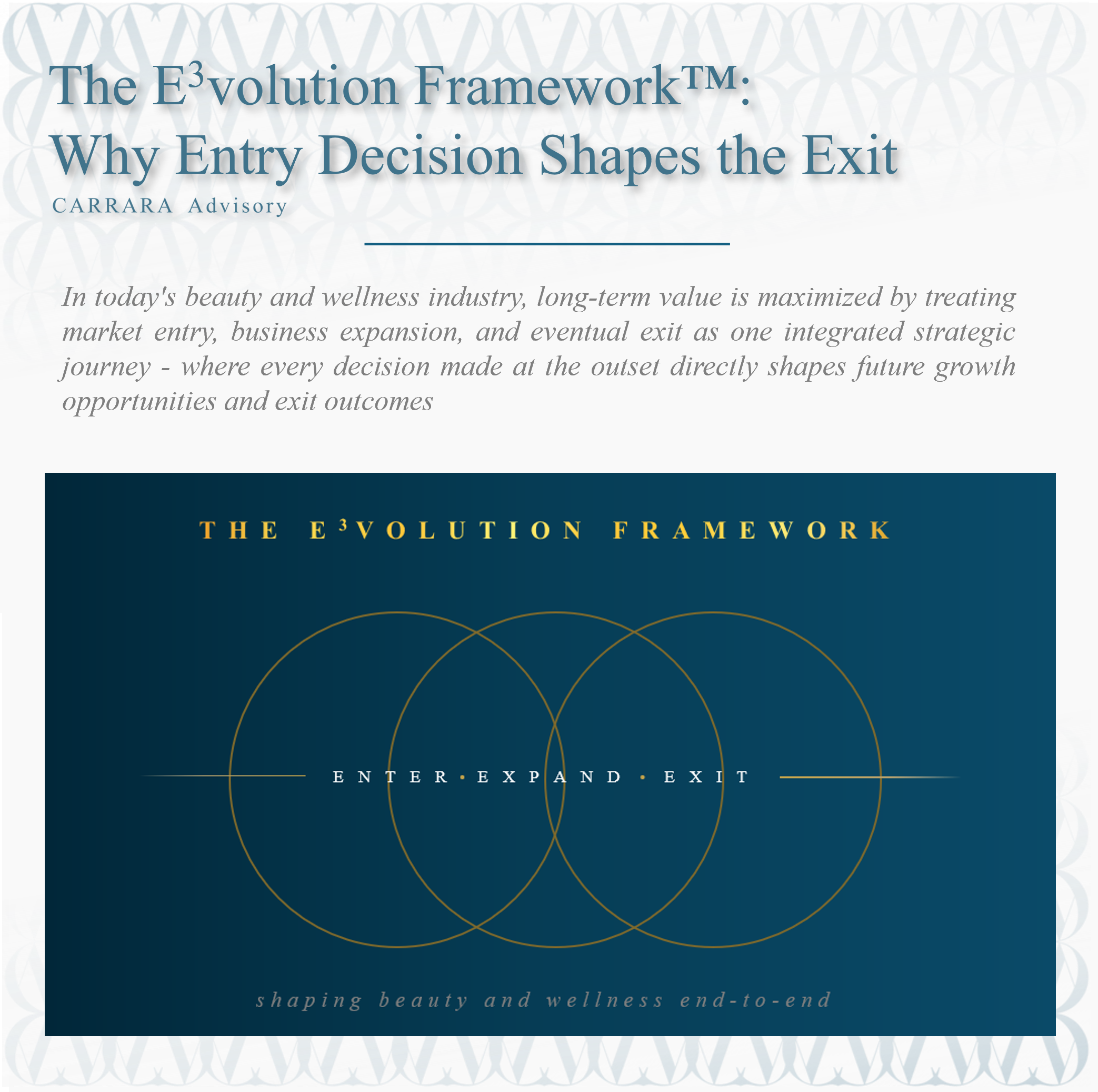
That continuity is what we call The E3volution Framework™: Enter, Expand, Exit. The principle behind it is simple: every decision made at entry either compounds into future optionality or quietly forecloses it. A licensing structure signed for speed at entry can make a clean divestiture harder five years later. A distribution footprint built for the wrong channel at expansion can suppress the multiple a buyer is willing to pay. We built this framework because we kept seeing the same failure pattern across mandates: founders and investors optimizing each phase in isolation, then discovering at the exit table that an earlier structural choice had already capped their outcome. Kering's reversal, from an in-house, acquisition-led beauty push back to a 50-year licensing deal with L'Oréal, at a cost running into billions, is the most vivid recent proof of exactly this dynamic, and it's worth unpacking in detail below.
The advent of disciplined resilience
The beauty industry has entered a more disciplined phase. Growth remains attractive, but capital has become selective, and operational excellence matters more than it has in a decade. McKinsey projects the sector will continue growing at roughly 5% annually through 2030, but increasingly through volume expansion rather than pricing power, as consumers grow more sensitive to inflation.
Scale still concentrates power at the top. L'Oréal remains the global leader, with 2025 sales exceeding €44 billion (~$47 billion), a reminder of what distribution and R&D scale actually buy. Unilever and Estée Lauder reinforce how concentrated global beauty remains among a handful of multinationals; a real structural headwind for new entrants who must compete against marketing budgets and supply chain efficiencies they cannot match on day one.
The broader wellness economy is growing even faster: from $6.8 trillion in 2024 toward a projected $9.8 trillion by 2029 (~7.6% CAGR, per Global Wellness Institute estimates). Beauty is increasingly a subset of a larger health and longevity movement, and the distinction between topical skincare and systemic wellness is blurring by the year.
ENTER — Earning the Right to Scale
The Enter phase is about earning credibility before pursuing scale. And, in our experience, choosing a structure that doesn't quietly cap your options three or five years later. Nowhere has this played out more visibly than in the last 24 months of luxury beauty deal-making.
Kering is the clearest recent proof of the thesis. In 2023, Kering launched Kering Beauté to centralize fragrance and cosmetics across its houses, anchoring the strategy with a €3.5 billion acquisition of niche perfume Creed. Bottega Veneta and Balenciaga moved in-house; Gucci stayed under its existing license with Coty through 2028. By the first half of 2025, the division was running a €60 million operating loss, and in October 2025 (under new CEO Luca de Meo and facing €9.6 billion in group debt) Kering sold the entire division to L'Oréal for €4 billion, including a 50-year licensing agreement covering Gucci, Bottega Veneta, and Balenciaga once the Coty deal lapses. In under two years, an in-house, acquisition-led entry strategy reversed all the way back into a licensing structure, at a cost of billions and a great deal of organizational disruption. That is the entry-shapes-exit dynamic playing out at the largest scale we've seen it.
Contrast that with Dolce & Gabbana, which moved the opposite direction and (so far) is succeeding: after decades cycling through licensees (Euroitalia, then P&G, briefly Coty, then Shiseido), it fully internalized beauty in 2023. The division is now valued at roughly €1.5 billion, with a target of €3 billion by 2027, despite a €13 million operating loss in the year to March 2024 tied to the investment required. Hermès and Chanel remain the standard for what disciplined in-house execution actually looks like. Both built over decades, with dedicated in-house perfumers and production, proving that in-house beauty doesn't require conglomerate scale to work. It requires expertise, patient capital, leadership continuity, and category-brand alignment; precisely what Kering's beauty division lacked, and what Richemont's own in-house fragrance division also struggled with before its division head departed just 18 months after launch.
The lesson generalizes beyond luxury fragrance. Fragrance is comparatively the easiest category to license or bring in-house; skincare and makeup carry far heavier regulatory, clinical, and formulation complexity, which is exactly why some licensing partners avoid those categories altogether, and why brands routinely underestimate what in-house really demands once they move past scent into treatment claims.
The structural decision most founders underweight. Beyond the marketing question sits a harder one: how do you actually enter the category? We generally see four viable paths:
Co-Development — we help you create and bring a new brand to market. A shared-risk partnership with a beauty group or entrepreneur: shared IP, shared upside. The middle path.
M&A — we help entrepreneurs or beauty groups scout, acquire, integrate, and manage beauty and wellness entities.
Licensing — we identify your licensee or licensor for entry into the beauty and wellness category. An established beauty group develops, produces and often distributes the products; the luxury or lifestyle brand keeps creative control, the beauty group carries the capital and operating risk. Fastest to market, lowest margin ceiling.
In-house — we build and manage your beauty division, acting as your external beauty department from idea and strategy through execution, manufacturing, and distribution relationships. Highest control and long-term value, highest capital and time commitment.
Each of these has a different exit shadow. Licensing deals often carry change-of-control or termination clauses that materially affect what a buyer will pay for the brand later; in-house structures maximize long-term value but require far more operational maturity to be sale-ready; co-development sits in between and depends heavily on how cleanly IP is separated at signing. Kering's own reversal (from an in-house, acquisition-led structure all the way back to a 50-year license) is this dynamic playing out at multi-billion-euro scale. We structure entry decisions with the exit already in view - not as an afterthought, but as a term in the negotiation.
EXPAND — Scaling Profitably, Not Just Loudly
Once credibility is established, Expand is about turning momentum into sustainable, profitable growth, and increasingly, investors are far less patient with "viral traction" that doesn't convert into unit economics.
The masstige opportunity. Continued pressure on discretionary spending is reinforcing demand for premium performance at accessible prices, an "efficacy over ego" dynamic that's a primary growth engine into 2026. Brands offering high-performance actives (stabilized vitamin C, patented peptides) in the low price range are showing the most consistent volume growth, and the cleanest path to scaling across both specialty and mass channels.
Geography: the Global South is no longer optional. Southeast Asia and India are projected to remain among the fastest-growing premium beauty markets through the decade. This isn't a matter of exporting Western SKUs; it requires reformulating for culture, climate and skin-type differences and navigating genuinely different regulatory regimes. Brands without a credible plan here risk losing their growth trajectory to those who move first.
The wellness convergence is now a distribution decision, not just a positioning one. The shift from "anti-aging" to "skin longevity" is showing up in AI-driven skin diagnostics, genetic testing, and ingestible beauty products with a growing evidence base linking gut health to skin outcomes. Brands that integrate topical and ingestible offerings are capturing more of a customer's total wellness spend, but this only works if the operating discipline behind it is deliberate, not improvised.
Where we actually operate. Capturing the opportunities above requires operating muscle most brands don't have in-house yet, which is why Expand covers five connected levers, not one:
Hands-on operating leadership — either a retainer-plus-success-fee model, where we take direct operational responsibility for commercial execution, portfolio strategy, and P&L accountability while you retain full ownership; or an equity partnership, where we take a minority stake in exchange for the same operating mandate, aligning our incentives directly with the brand's upside.
Distribution architecture — building a distributor network that actually reorders and holds pricing: territory and exclusivity terms, margin corridors that survive across markets, and the account-management discipline that determines whether a network sells or quietly stalls.
Business Turnaround, through Atelier CARRARA — a two-phase model. GRAIN LAB™ handles diagnostic and strategy framing across organizational effectiveness, supply chain, brand positioning, and financial discipline; SCULPT STUDIO™ is hands-on implementation, including interim or fractional leadership where a function needs expertise it doesn't yet have.
Talents & Culture, embedded in every mandate, no commercial transformation survives disengaged teams, so leadership alignment and change management run underneath the other levers, not as an afterthought bolted on at the end.
Growth via acquisition — when scaling means buying a brand, a distributor, or a manufacturing asset, this is where Expand hands off to our Exit practice for execution: scouting, valuation, structuring, integration.
The masstige and Global South opportunities above are only capturable if this operating discipline is actually in place (SKU rationalization, margin protection, the right in-market leadership). In most of the stalled-growth mandates we see, the market opportunity was never the problem. The operating muscle to capture it was.
EXIT — Realizing the Value You Built
Within the Architecture, Exit doesn't mean simply selling. It means maximizing the range and quality of long-term value-creation options you've earned the right to, some of which may not involve a sale at all.
Beauty still commands a premium. High-quality beauty assets continue to attract double-digit EBITDA multiples, well above the broader consumer goods average, reflecting sustained strategic and PE interest even in a more disciplined market.
The recent deals tell a more nuanced story than the headlines suggest. Unilever's $1.5 billion acquisition of Dr. Squatch signaled real conviction in men's grooming. L'Oréal's roughly $1.0–1.1 billion majority stake in Medik8 (at an estimated 14.7x trailing revenue) reflects strong appetite for scientifically credible, profitable skincare. e.l.f. Beauty's acquisition of Rhode, by contrast, closed at roughly $800–900 million (with a further earnout tied to growth), around 3.8–4.7x trailing revenue rather than an EBITDA multiple, a useful reminder that headline "billion-dollar" deals aren't interchangeable. Revenue-multiple deals for high-growth, not-yet-fully-profitable brands are a different animal from EBITDA-multiple deals for established, profitable ones, and they get priced, negotiated, and structured differently. Knowing which category your business sits in, and building toward the more favorable one, is itself a strategic decision, not a fact you discover at the term sheet.
The integration risk deserves more attention than it gets. Not every founder believes full integration into a conglomerate maximizes long-term value. MAC and Too Faced are frequently cited as brands whose original spirit and growth trajectory dimmed after acquisition. This is why we increasingly advise clients to weigh partial or strategic-alliance structures (private equity platforms, minority stakes, licensing-out arrangements) even at a lower headline number, when full integration risks the thing that made the brand worth buying in the first place. A slightly lower multiple attached to genuine operating independence is, in a meaningful number of cases, the better outcome and not the consolation prize.
Where our own data comes in. This is exactly the judgment AIVALS™ and TRINACRIUM™ exist to sharpen. Our M&A intelligence tools remove the emotional part of the valuation exercise. AIVALS™ combines proprietary transaction intelligence and quantitative AI modeling to estimate valuation multiples for beauty and wellness companies. The model explains approximately 94% of historical transaction multiple variation and predicts observed EV/Sales multiples with an average error of roughly 0.6x, built on ~1,300 transactions and validated on ~400 cases. TRINACRIUM™ turns that same intelligence into an ongoing framework for portfolio monitoring and value creation, not a one-time diagnostic. That's a different kind of signal than reading the same public deal announcements everyone else reads; it comes from having actually built and maintained a proprietary base of beauty and wellness transactions.
Operational Maturity Is the Real Foundation
Across every deal above, the pattern holds: the transition from high-growth startup to high-value exit requires an operational maturity many founders build too late. Consumer switching behavior has intensified, brands can no longer rely on past success, and must continuously prove efficacy and value to retain customers through the Expand phase. The most attractive acquisition targets today have demonstrated a sustainable path to profitability, not just revenue growth or social following, the market has moved decisively toward rewarding the former.
Strategic Implications
For operators:
Match your entry structure to your category's real complexity. Fragrance is comparatively forgiving; skincare and makeup carry regulatory and clinical demands that punish an underprepared in-house move.
If you go in-house, bring patient capital and leadership continuity, not just ambition. Hermès, Chanel, and (so far) Dolce & Gabbana succeeded on expertise and time, not scale; the two things Kering's and Richemont's beauty divisions lacked.
Treat distribution and operating discipline as the real growth bottleneck. The masstige and Global South opportunities are only capturable with the SKU rationalization, margin protection, and in-market leadership to execute them.
Structure for the exit from day one. A considered entry structure (co-development, M&A, licensing, or in-house) is an exit-readiness decision made years before an exit conversation starts, not a term to renegotiate under pressure later.
For investors:
Look for masstige potential — brands offering high-end performance at accessible price points are best positioned to navigate volatility.
Weight the Global South seriously — brands with a credible Southeast Asia/India strategy are likely to outperform peers without one.
Evaluate unit economics over viral metrics — sustainable profitability remains the most reliable predictor of exit multiple.
Distinguish revenue-multiple deals from EBITDA-multiple deals when benchmarking targets. They are not the same asset class, and treating them as such is a common valuation error.
The path from entry to exit in beauty and wellness is harder than it was a decade ago, and the rewards for getting it right are correspondingly larger. The brands that will define the next era are the ones that treat Enter, Expand, and Exit not as three separate mandates, but as one continuous architecture for value creation, which is precisely the lens The E3volution Framework™ is built to provide.