Profit Starts with Price: The Real Strategy Behind Successful Beauty Brands

Pricing is one of the most powerful levers in any beauty business, yet it remains one of the least professionally managed. Several mid-market beauty brands grow through creative product development, strong founder vision and early channel wins. As they scale, pricing is rarely revisited with the analytical discipline it deserves. This oversight silently erodes margin, weakens cash flow, and eventually limits growth capacity. For brands that are scaling up, pricing can often be the difference between a business that expands internationally and a business that stagnates due to internal financial pressure.

Understanding how pricing influences your profit requires moving beyond simplistic views of discounts or markups. Pricing affects almost every function of a beauty company. It shapes how consumers perceive quality. It influences the behavior of distributors and retailers. It impacts operational requirements and cash cycles. It determines whether you can reinvest into marketing, innovation and recruitment. Ultimately it defines the resilience of the company when market conditions shift. Pricing is not a value added after everything else, but a strategic foundation that guides the financial architecture of the entire brand.

This article explores the mechanisms through which pricing impacts profitability, the patterns commonly seen among mid-market beauty and wellness companies, and the concrete steps leadership can take to bring pricing under control. The goal is to provide immediate clarity, practical frameworks and actionable insights that can be applied regardless of the company’s size or channel mix.

The role of pricing in perceived value

Beauty is one of the most signal-driven categories in consumer goods. Price acts as a shortcut for consumers who assess quality, reliability and ingredient integrity without having deep technical knowledge. When a serum, cleanser or foundation sits at a certain price point, it sends a message about where the brand positions itself in the competitive landscape. If your pricing is out of alignment with product promise, packaging, brand narrative or retail environment, you will face resistance. In contrast, a well-harmonized pricing strategy creates coherence and confidence.

A mid-market brand often suffers from silent misalignment. A brand may have upgraded packaging but kept old pricing. Another may have improved formulas but kept prices artificially low due to fear of customer pushback. Others might have launched new product lines that unintentionally dilute the perceived value of the hero products. Each of these cases contributes to a subtle but significant erosion in the consumer’s mental model of the brand. A luxury skin care brand that prices too conservatively is not perceived as accessible but as inconsistent. On the other hand, a mass market brand that raises prices without strategic justification quickly loses elasticity and damages volume.

The strongest brands treat pricing not as a number but as a signal. They know that the price communicates quality, identity and confidence. When a pricing structure aligns perfectly with what the brand stands for, customers accept it naturally and retailers support the positioning because they can clearly see how the brand fits within the category.

How pricing affects contribution margin and operating margin

Contribution margin is where the real conversation on pricing must begin. Every euro or dollar added to price flows almost entirely to contribution margin. Costs do not increase when you adjust price upward within reasonable bands. For this reason pricing is often the single most powerful profitability lever available to a mid-market beauty company.

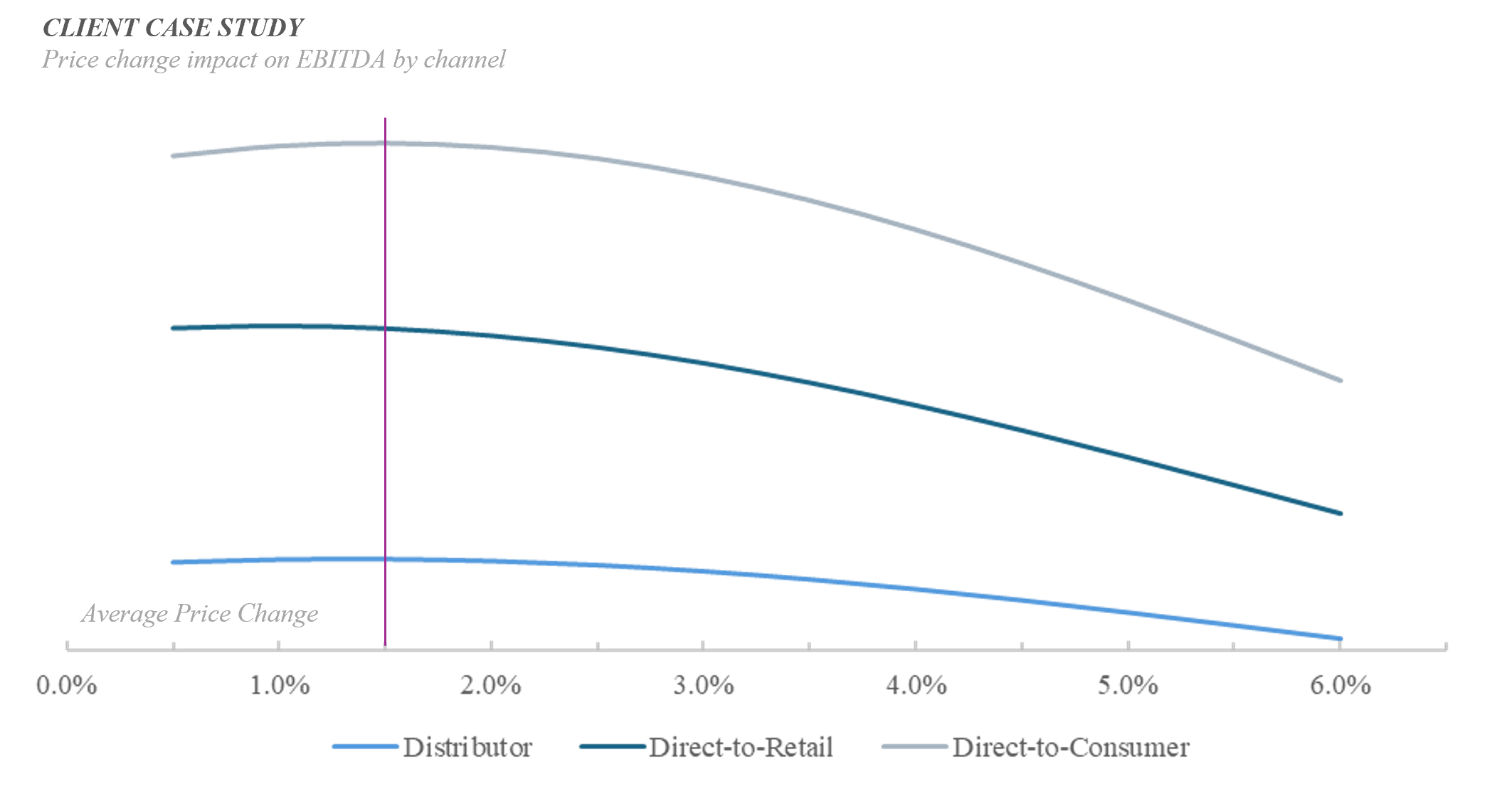
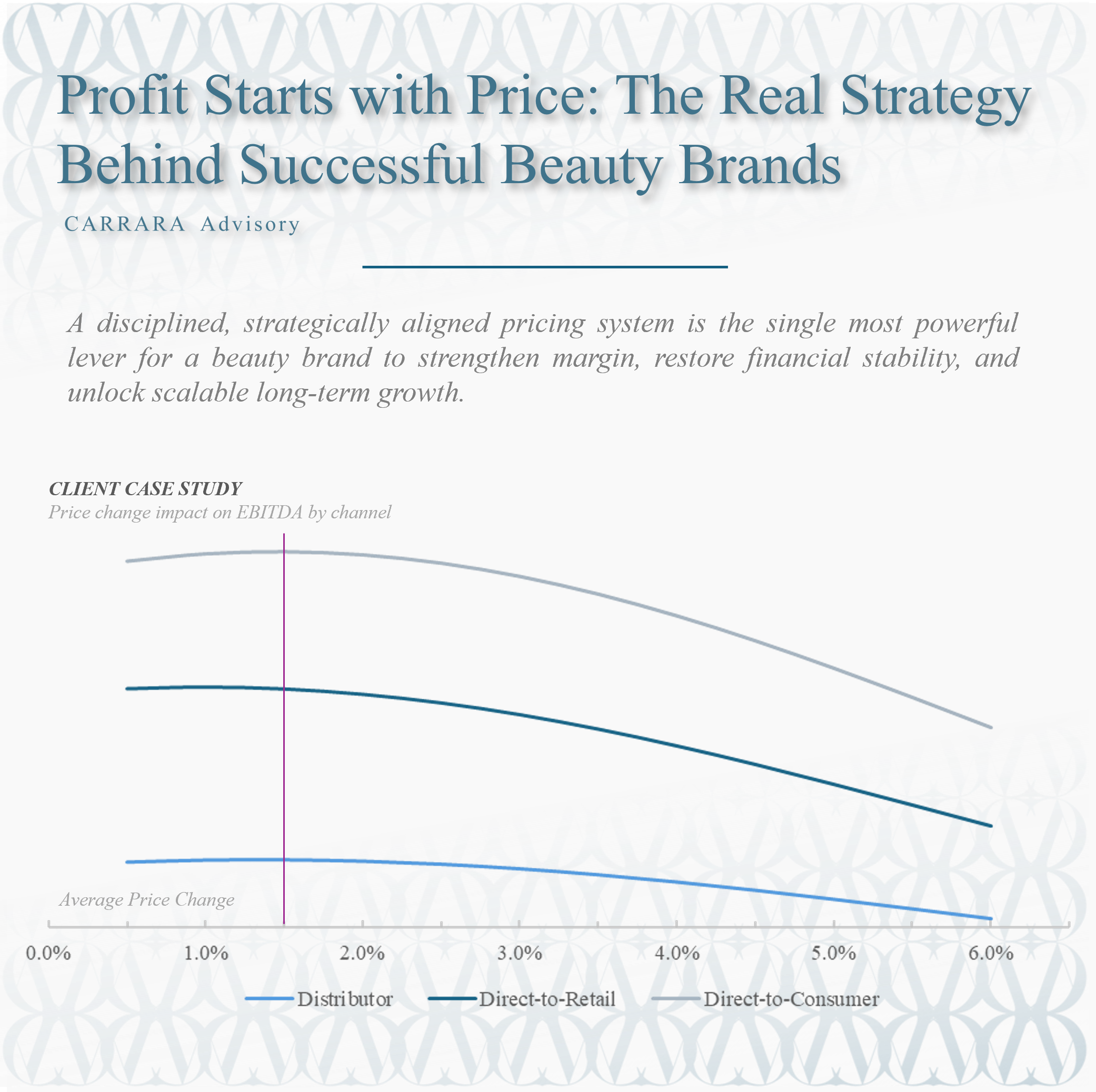
Case Study Insight — Pricing Optimization for EBITDA Growth

A key lever in the Gen-Z brand acceleration was strategic pricing optimization, executed with analytical rigor rather than intuition. We built a model to evaluate the impact of incremental price adjustments on EBITDA by channel, assuming all other costs remained constant and adjusting only for the brand-specific price elasticity of demand. This approach allowed us to quantify the absolute financial effect of pricing decisions rather than relying on relative or heuristic estimates.

The results were instructive. Across all channels, the model identified an optimal price increase of +1.5%, a modest adjustment that maximized absolute EBITDA. At the channel level, the impact was differentiated:

  • Direct-to-consumer (DTC): +5% EBITDA

  • Direct-to-retail: +1.5% EBITDA

  • Distributor channel: +4.2% EBITDA

Weighted across the entire business, this translated to a +3.8% increase in total absolute EBITDA, achieved without additional operational investment or cost reduction.

This exercise demonstrated several important principles for mid-market beauty brands:

  1. Small, targeted price adjustments can materially improve profitability when calibrated to channel dynamics and price sensitivity.

  2. Channel-specific analysis is critical—a uniform price change may underperform if elasticity differs across channels.

  3. EBITDA modeling creates a disciplined decision framework, turning pricing from a reactive tool into a proactive driver of growth.

By integrating this pricing optimization into the broader brand and distribution strategy, the client not only improved short-term profitability but also built a repeatable methodology for future pricing decisions, aligning financial outcomes with strategic brand positioning.


When contribution margin improves, the company suddenly has oxygen. Management can invest in new product development, in professional marketing campaigns and in operational upgrades. Most importantly, the company gains resilience. Beauty brands with high contribution margins can absorb shocks from supply chain disruptions, retailer chargebacks, inventory write offs or increases in customer acquisition costs. Brands with thin contribution margins collapse under the same pressures.

Operating margin is influenced by pricing in a more complex but equally important way. When prices are too low relative to the true cost of operations, the company starts compensating through volume. But volume in beauty is expensive to acquire. Paid acquisition, trade marketing, sales teams and retail activations all cost money. When brands underprice themselves, they are effectively committing their organizations to an endless chase for higher volume. This creates operational stress and financial instability.

A well balanced price architecture reduces this pressure. The company no longer needs to grow volume aggressively to maintain stability. Leadership gains more strategic flexibility and can focus on brand building rather than constant firefighting.

The hidden cost of inconsistent pricing across channels

One of the most common sources of margin erosion comes from pricing inconsistencies between channels. Many mid-market beauty brands operate across a mixture of direct to consumer, retail and professional channels such as spas or salons. Each channel follows different rules. Retailers require certain markups, distributors expect their own discounts/price structure, professional partners negotiate special conditions, and direct to consumer pricing is usually determined by competitive dynamics.

When pricing structures were never designed but instead emerged organically over years of growth, the result is silent complexity. A product may end up priced too low in one channel relative to others, creating channel conflict. Retailers refuse to push a brand that undercuts them online. Distributors lose interest if the direct channel sets prices far below their own retail networks. Consumers become confused when the same product sits at multiple price points across different environments.

Channel conflict does not only damage brand perception but directly reduces profitability. Retail partners request additional support, distributors demand greater discounts, and the brand eventually absorbs the cost of reconciliation. This is rarely obvious on the balance sheet. It shows up in weak sell through, poor reorders and reduced visibility within the retailer’s promotional calendar.

Brands that manage pricing consistently across channels enjoy stronger bargaining positions. Their partners take them seriously. Their trade terms remain stable. Their promotions deliver predictable returns. Most importantly, a unified price architecture strengthens the brand’s long term strategic footing.

The impact of promotions on long term price integrity

Beauty brands often rely heavily on promotional activity to stimulate demand. While promotions can be effective, they also create long term damage when mismanaged. Every time a brand discounts without a clear strategic reason, it trains customers to expect lower prices. Over time this habit becomes ingrained in the market. Customers wait for promotions before purchasing. Retailers ask for deeper discounts. The direct channel loses pricing authority. The result is a slow but steady erosion of base price integrity.

When promotional activity is not anchored in a disciplined strategy, it becomes a substitute for operational excellence. Brands use promotions to compensate for weak product storytelling, inadequate channel planning or poor inventory management. This creates a downward spiral. The company must promote more frequently to maintain volume, and the profitability of each unit declines. Margins compress and the brand loses financial flexibility.

A professional pricing strategy treats promotions as a carefully managed component of the value architecture. Promotions should be tied to specific strategic goals such as customer acquisition, seasonal resets or limited inventory clearances. They should never be used to artificially stimulate demand that has not been earned through strong fundamentals. The more rigorously a company manages its promotions, the more disciplined the entire organization becomes.

The risk of cost inflation without pricing adjustment

In the last several years ingredient prices, packaging costs and logistics expenses have fluctuated dramatically. Brands that failed to adjust pricing in response to inflation quickly found themselves squeezed. Many mid-market beauty companies delayed price increases due to fear of customer backlash. They assumed inflation would pass quickly or that competitors would hold. Instead, inflation accumulated into structural pressure, forcing companies to operate with reduced profitability.

The inability to adjust pricing leads to a combination of negative effects. Many of these pressures are amplified by poor operational planning and weak cost visibility, issues we have examined in detail in an earlier article on how bad planning silently inflates COGS and erodes profitability. Cash flow weakens. Inventory financing becomes more burdensome. Marketing budgets are cut, which harms sales. Leadership becomes overly cautious and stops investing in growth. The brand begins losing its competitive rhythm.

When pricing does not reflect the true cost base of the business, the organization enters a state of quiet distress. The company might not be in crisis, but it no longer has the internal strength to pursue new opportunities. Beauty brands that avoid adjusting prices during inflation often find themselves in trouble long after inflation stabilizes because they never corrected the structural imbalance.

Why founders fear price increases and why the fear is usually unfounded

Founders and CEOs of mid-market beauty brands often hesitate to raise prices. They fear losing customers, upsetting retailers or appearing opportunistic. This fear is understandable but mostly based on intuition rather than data. The truth is that consumers in the beauty category tolerate price increases far more than leadership expects. The category is intrinsically emotional. When customers believe in a product, trust the brand and perceive quality, they accept moderate increases with minimal resistance.

The greater risk lies in failing to raise prices when necessary. Underpricing undermines the brand and signals insecurity. It reduces the financial resources required for product development, marketing excellence and innovation. Over time, staying artificially cheap becomes a much greater threat than the potential backlash from a well calibrated price adjustment.

Brands that conduct careful price elasticity studies, even informally, often discover that demand remains stable through a few percent adjustment. The financial impact of such a movement is substantial. The company strengthens its margin, its cash flow and its resilience. In many cases a controlled price increase becomes the catalyst for renewed strategic momentum.

The operational consequences of poor pricing

Pricing decisions are not limited to revenue and margin. They influence the efficiency of the entire operation. Underpriced products force the organization to chase volume, which requires larger sales teams, larger inventory levels and heavier marketing expenditure. This creates additional operational stress. Warehousing becomes more complex. Production schedules become more demanding. Customer service workloads increase. The company becomes a high friction business that burns energy and capital.

Poor pricing also interferes with forecasting. When promotions distort demand patterns, supply chain teams cannot accurately predict volume. This leads to excess inventory, stock outs or unnecessary working capital consumption. The brand spends more time firefighting than building.

Operational inefficiency is rarely attributed directly to pricing, yet pricing is often the root cause. A properly designed pricing model simplifies planning, stabilizes volume expectations and reduces the operational burden.

How pricing interacts with brand architecture

Beauty brands with multiple product lines face additional complexity. Each line must sit within a coherent pricing ladder. When pricing architecture fails to follow a logical progression, customers get confused. A mid-tier line may be priced too close to a premium line. A hero product may unintentionally be cheaper than secondary products. These mismatches cause friction at the point of sale and weaken consumer understanding.

A clean pricing architecture guides customers through the brand portfolio intuitively. High value products sit at the top of the ladder and reinforce the brand’s identity. Entry products provide accessibility without undermining the premium position. When the ladder is well constructed, it increases average order value, improves consumer trust and boosts profit per transaction.

Price-to-Design vs Design-to-Price: What Beauty Brands Must Understand

In the beauty industry, pricing strategy cannot be an afterthought. Unlike categories such as high-end watches or jewelry, where brands enjoy the freedom to design first and price later, beauty brands must begin with a clear price positioning. The target price anchors every subsequent decision (formulation, packaging, sourcing, and distribution) ensuring that the product can be delivered profitably while maintaining the intended brand perception. Without this disciplined approach, mid-market beauty brands risk creating products that are either too costly for the intended consumer segment or insufficiently differentiated, undermining both margin and market positioning.

Luxury industries often operate in the opposite sequence. Watchmakers and jewelry houses design products guided primarily by creative intent, technical ambition, or craftsmanship considerations. Pricing is determined afterward, typically justified by scarcity, heritage, or symbolic value rather than cost constraints. The high consumer tolerance for luxury pricing, coupled with slower product cycles, enables this design-first logic. In this model, contribution margin is almost secondary; the value exists in perception, and production can be scaled or absorbed to support brand storytelling.

Beauty, by contrast, demands a price-first, cost-constrained discipline. A mid-market skincare line, haircare collection, or cosmetic range cannot rely on aspirational storytelling alone to sustain price points. Every ingredient choice, packaging upgrade, or channel expansion must be evaluated against the pre-defined price architecture. Contribution margin is central; cost of goods must align with what the market is willing to pay. Operational feasibility and financial sustainability are inseparable from strategic price positioning. This approach ensures that premium positioning is achievable in reality, not just in marketing materials.

Brands that fail to internalize this logic frequently make two common errors. First, they allow creative ambition to drive costs beyond what their target price can support, producing products that are either unprofitable or require discounting to sell. Second, they underestimate the impact on channel economics, creating friction between retail, direct-to-consumer, and professional distribution. Both missteps erode margin, weaken negotiation power, and compromise long-term brand equity.

The lesson is clear: in beauty, pricing is the foundation. Product development is subordinate to it. In high luxury, the opposite is true: design dictates price, and margins are often justified by perceived value rather than unit economics. Recognizing this distinction allows leadership to make rational, structured decisions about portfolio strategy, investment in innovation, and channel execution. The contrast is particularly visible when examining how luxury watchmaking constructs value upstream, a model we analyzed in a dedicated article.

 The strategic framework for rebuilding pricing discipline

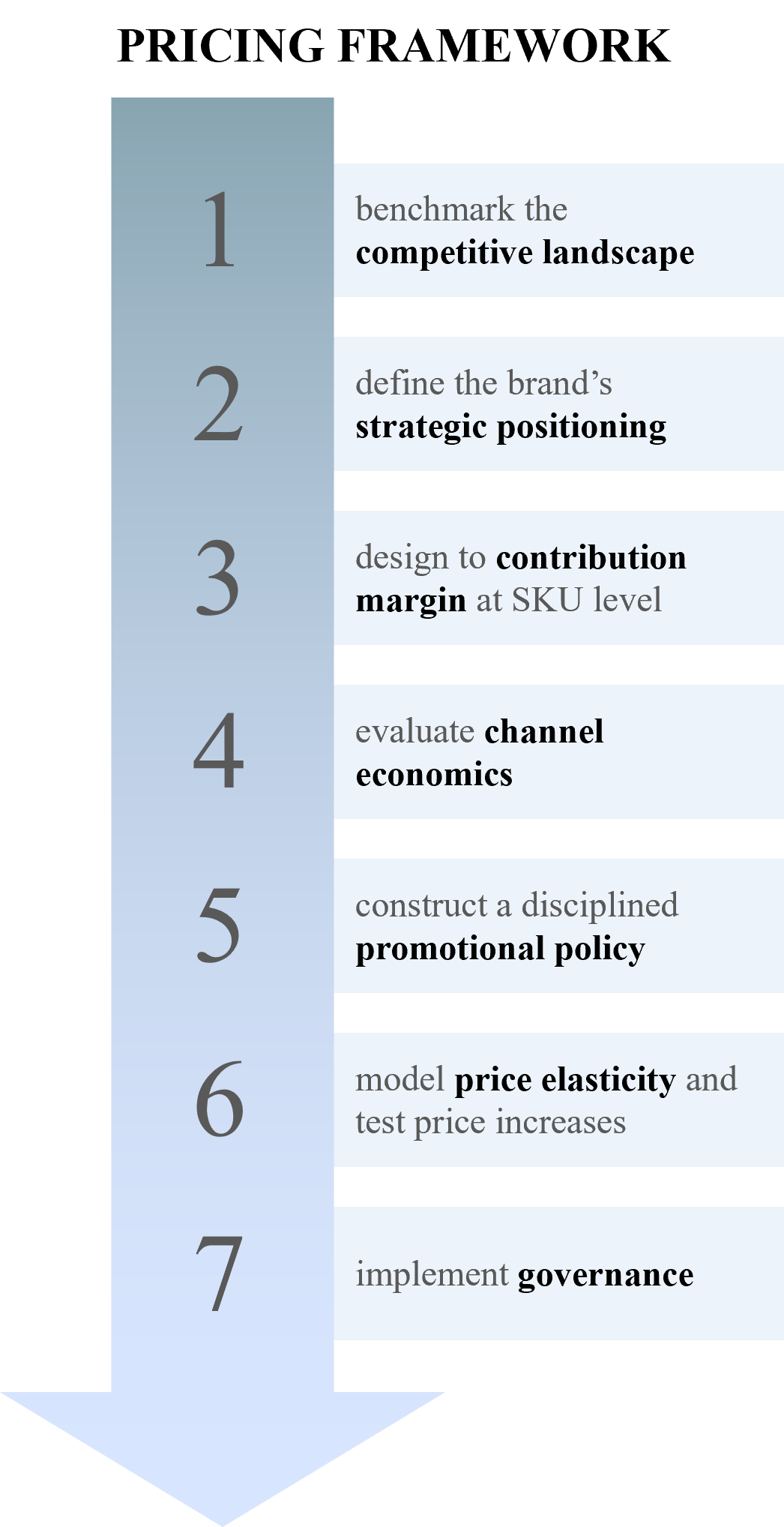
Pricing excellence requires systematic discipline. The following framework can guide leadership teams who want to bring structure and clarity to their pricing model.

1.      Benchmark the competitive landscape. This does not mean copying competitors but understanding the price signals in each subcategory. Benchmarking should highlight where the brand is underpriced or overpriced relative to its promise.

2.      Define the brand’s strategic positioning with precision. The brand must decide whether it competes on premium differentiation, clinical efficacy, natural formulation, innovation leadership or mass accessibility. Pricing must reflect this identity. Without a clear strategic anchor, pricing becomes arbitrary.

3.      Design to contribution margin at the SKU level. Profitability must be understood at line item detail. Many mid-market brands underestimate the variation in margin between products. Some products may carry the company while others silently erode profitability. SKU level clarity is essential before any pricing decision.

4.      Evaluate channel economics. The company must understand the impact of trade terms, distributor discounts and retail markups. Pricing must be harmonized across channels to avoid conflict. If necessary, the brand should redesign its entire pricing ladder to ensure coherence.

5.      Construct a disciplined promotional policy. Promotions must be tied to clear objectives. The company should quantify the long term impact of discounts on margin and customer behavior. Leadership must adopt the principle that promotions are a strategic tool, not a crutch.

6.      Model price elasticity and test controlled price increases. Even moderate increases can have a large financial impact. Testing allows the company to understand consumer behavior and fine tune the architecture.

7.      Implement governance. Pricing decisions must not be left to intuition or external pressure. The company should establish a pricing committee or at least a structured review process. Pricing discipline comes from process, not personality.

How pricing strengthens negotiation power with retailers and distributors

A brand with a coherent, data-based pricing architecture commands respect from its partners. Retailers see the brand as stable, predictable and professionally managed. They become more willing to provide visibility, promotions and placement. Distributors gain confidence that the company understands market dynamics and protects their commercial interests.

On the other hand, retailers and distributors immediately sense when a brand is uncertain about its pricing. They push harder, request deeper discounts and demand more support. The brand becomes reactive, losing leverage and accepting terms that gradually weaken profitability.

A disciplined pricing strategy reverses this relationship. Instead of reacting to retailer pressure, the brand leads the conversation. It sets expectations, defends its margins and builds partnerships based on mutual respect. Strong pricing is a foundation for strong commercial relationships.

The compounding benefits of pricing discipline

When a beauty brand rebuilds its pricing structure, the benefits go beyond immediate financial gain. Pricing discipline strengthens internal accountability. It forces clarity on product profitability, channel strategy and brand narrative. It encourages better forecasting. It reduces operational waste. It creates confidence among investors and partners. Most importantly, it provides leadership with a stable financial base from which to pursue growth.

Pricing is one of the few strategic levers that can deliver rapid impact without requiring additional capital. It is a lever entirely within the company’s control. When applied correctly, pricing becomes a source of strength, clarity and strategic momentum.

Final considerations

Many mid-market beauty companies believe their challenges are rooted in marketing or distribution. In reality, a significant portion of their difficulties stem from pricing misalignment. When pricing does not reflect the true value of the brand, the company fights against gravity. Every sale becomes harder. Every investment becomes riskier. Every operational decision becomes more fragile.

A disciplined pricing strategy brings order where there was confusion. It strengthens profitability, stabilizes the organization and unlocks growth capacity. It signals confidence to consumers and professionalism to partners. For beauty brands operating in a competitive and fast moving landscape, pricing excellence is not optional. It is a strategic necessity.

If leadership approaches pricing with the same seriousness applied to product development and brand storytelling, the entire organization becomes more resilient and more capable. Pricing is not simply a number. It is the financial backbone of the brand. When mastered, it changes the trajectory of the business.

Next
Next

The Real COGS Killer: Bad Planning.