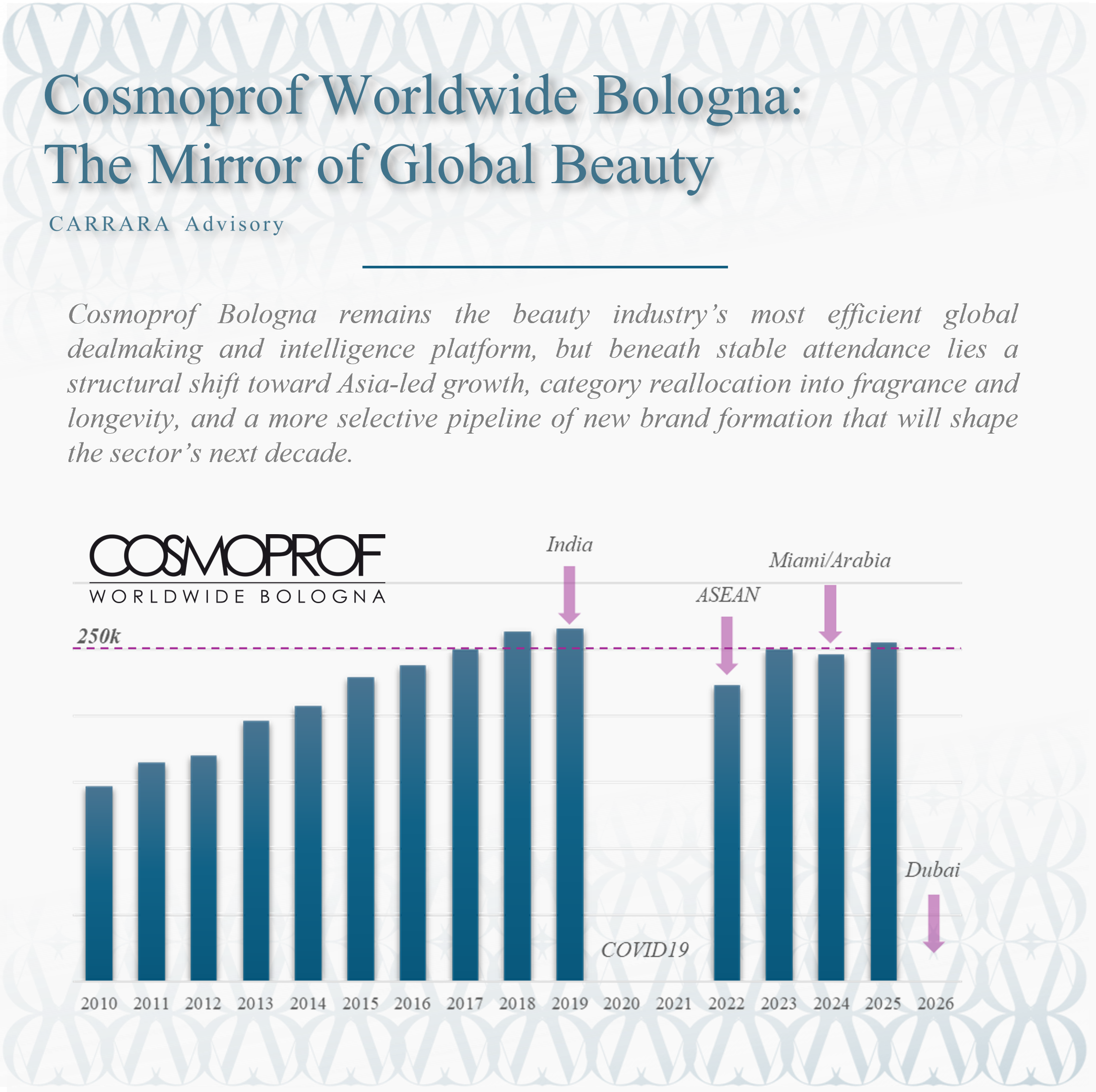
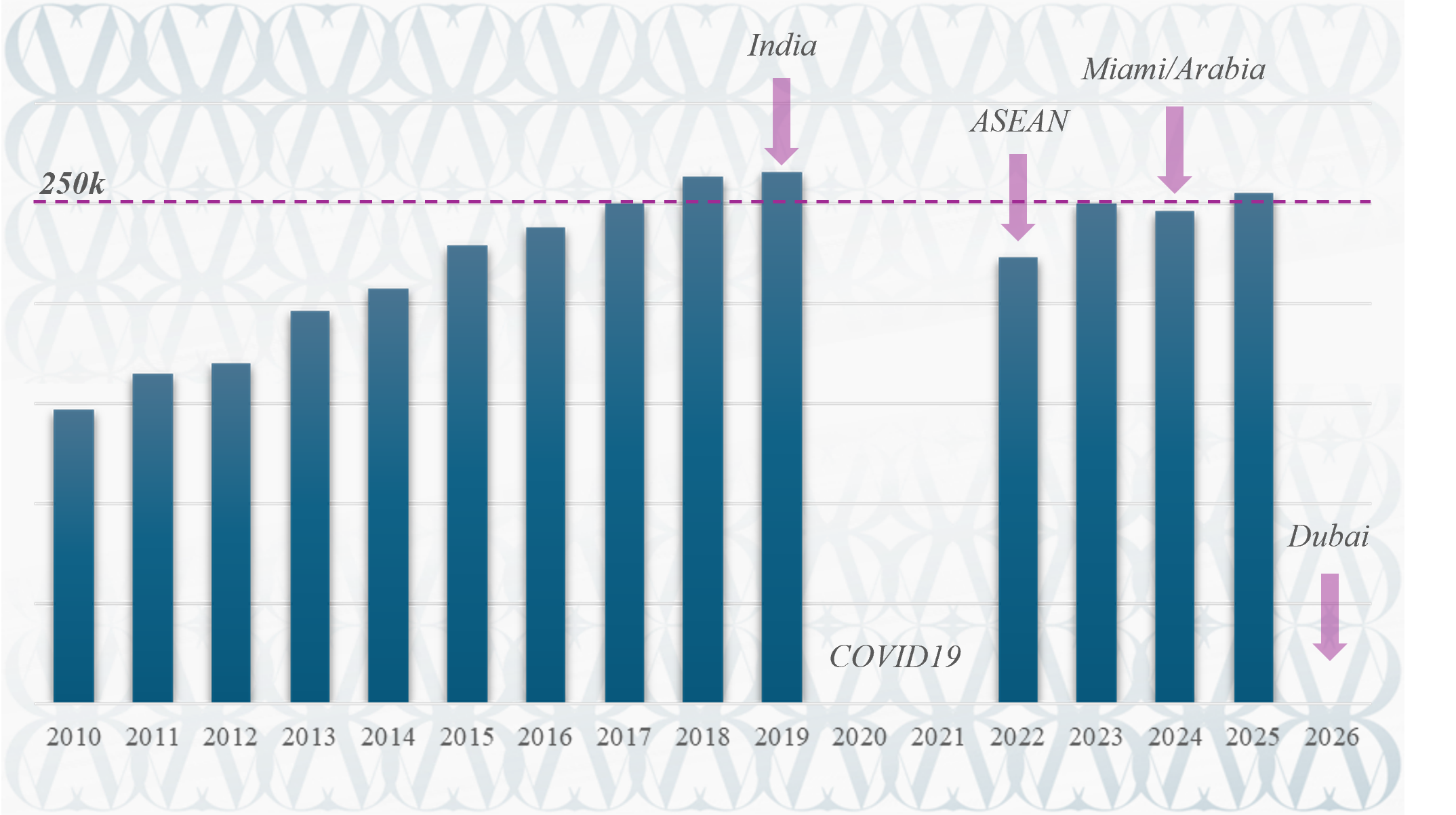
* Derived estimates based on year-over-year growth disclosures or source averaging. Sources: BolognaFiere official press releases, CARRARA Advisory reconstruction.
What the graph makes plain is that the post-pandemic recovery has been strong but has settled into a plateau. The 2022 return edition drew 220,000 visitors, roughly 45,000 fewer than the 2019 peak. By 2023, Cosmoprof had largely recaptured its pre-pandemic audience. The 2025 edition at approximately 255,500 represented a near-record. Yet the trajectory from 2023 to 2025, essentially flat at around 248,000 to 255,000, also suggests that the event may have reached a natural ceiling in raw attendance, set partly by the physical capacity of Fiera Bologna and partly by the evolution of the buyer population itself.
Who Comes to Cosmoprof, and Why It Matters
Understanding Cosmoprof's value requires understanding who actually attends and what they are trying to accomplish. The fair is not a consumer event. There are no end-consumers browsing shelves, no influencer activations designed for social media reach, and no retail promotions. It is a B2B event in the most literal sense: a structured environment in which the full beauty supply chain convenes to conduct business, from raw material suppliers and contract manufacturers to finished product brands, packaging designers, and distribution buyers.
The fair is organized around three dedicated shows held simultaneously. Cosmopack covers the upstream supply chain: ingredients, packaging, contract development and manufacturing, machinery, and private label services. Cosmo Perfumery and Cosmetics hosts finished product brands seeking retail distribution, from established international names to smaller niche launches. Cosmo Hair, Nail and Beauty Salon anchor the professional sector, covering haircare, nail products, skincare devices, and salon equipment. In 2026, the three shows together hosted more than 3,000 exhibitors from 64 countries, representing over 10,000 brands.
For a brand entering the European or global market, Cosmoprof offers something that no digital platform replicates: concentrated, qualified access to buyers, distributors, retailers, and potential manufacturing partners across four days. A mid-sized skincare brand from South Korea can meet representatives from Sephora Europe, three Spanish pharmacy chains, a German distributor, and a Swiss CDMO in a single afternoon. The geographic density and profile density of the buyer base is simply not reproducible through any alternative channel. This is what has sustained Cosmoprof's relevance even as the industry has digitized: the deal-making and partnership-formation function remains irreducibly physical.
The fair is also a signaling mechanism. Which brands are exhibiting for the first time? Which categories are receiving disproportionate floor space? Attentive visitors learn as much from the architecture of the fair floor as from the conversations it facilitates. In 2026, the growth of dedicated beauty technology areas, covering AI-enhanced retail diagnostics, personalization platforms, and skin analysis tools, was visible in both the exhibitor roster and the CosmoTalks programming. Fragrance occupied more floor space than in any edition in recent memory. The longevity and biotech skincare cluster, still nascent in 2023, had by 2026 become one of the fair's most commercially active zones.
Cosmoprof is not merely a trade fair. It is the industry's annual general meeting: the moment at which commercial relationships are renewed, strategic intelligence is gathered, and the direction of the next twelve months of investment and launch activity begins to take shape.
Should You Be There? A Framework by Business Type
The question of whether to attend Cosmoprof, and in what capacity, is not self-evident. The answer depends fundamentally on what kind of business you are running and what you are looking for. The fair is not equally useful for all participants, and the cost of attending, including the time, travel, and stand investment where applicable, has increased enough in recent years to make the calculus worth examining explicitly.
For finished product brands seeking international distribution, Cosmoprof Bologna remains the most efficient single week of the year, provided the brand is ready for commercial conversations rather than exploratory market research. A brand with a clear positioning, a qualified product range, and the organizational capacity to follow up with buyers will find no equivalent concentration of qualified retail and distribution decision-makers anywhere in the world. The buyer program that BolognaFiere operates, which facilitates pre-scheduled meetings with vetted distributors from over 150 countries, is a genuine accelerator for brands at the scaling stage. For a brand still refining its concept or building its first formulations, the same investment would yield far less return, and the fair floor can create a misleading impression of readiness.
For contract manufacturers and CDMOs, Cosmoprof is close to indispensable, particularly for those with European or Italian manufacturing capabilities. The Cosmopack hall is where the industry's sourcing conversations happen at scale, and the combination of inbound interest from Asian brands seeking European manufacturing credibility, emerging market brands seeking reliable formulation partners, and the growing wave of science-backed brands requiring clinical-grade production standards creates a buyer profile that is difficult to access through any other channel at comparable density. The fair is especially valuable for CDMOs positioned in the mid-to-premium segment, where the differentiation between manufacturing partners is meaningful and where the face-to-face evaluation of capability and culture matters as much as the technical specification.
For raw material and ingredient suppliers, the calculus is more nuanced. The most commercially active ingredient houses use Cosmopack as a brand-building and relationship-maintenance platform as much as a direct sales channel, given that ingredient purchasing decisions typically run through lengthy technical evaluation cycles that begin at the fair but close months later. For an ingredient supplier launching a genuinely novel active with differentiated clinical data, Bologna offers unmatched access to the formulation teams and R&D directors at major brands. For a supplier of commodity inputs competing primarily on price, the fair is less productive than targeted direct sales activity.
For packaging and component suppliers, Cosmoprof's value proposition is straightforward: it is the largest single gathering of packaging decision-makers in the beauty industry, and the ability to showcase design innovation and sustainability credentials to that audience in a physical context that allows tactile evaluation is commercially meaningful. The challenge for packaging suppliers, as for other upstream categories, is managing the lead time between fair contacts and purchase orders, which can run to 12 to 18 months.
For service providers, including regulatory consultants, logistics specialists, testing laboratories, technology vendors, and advisory firms, Cosmoprof serves primarily as a market intelligence and relationship maintenance platform rather than a direct revenue generator. The fair's density of industry professionals in a single location creates an efficient environment for tracking market evolution, identifying emerging client needs, and reinforcing relationships with existing partners. The ROI calculation is less transactional than for product-oriented exhibitors and depends heavily on the quality of pre-arranged meeting schedules.
For investors, the fair functions as a live due diligence tool that no financial model replicates. Walking the floor systematically across multiple editions, tracking which categories are gaining commercial momentum, which brands are investing in larger stands, which new geographies are asserting themselves as supply-side players, and which exhibitor cohorts are growing or contracting provides a qualitative intelligence layer that complements the quantitative analysis. Several of the most successful beauty M&A transactions of the past decade were seeded by relationships built on the Cosmoprof floor years before the formal process began.
The question is not whether Cosmoprof is valuable. It is whether you are ready to extract that value. Attending before your commercial proposition is fully formed is expensive market research. Attending when you are ready to close deals is one of the most capital-efficient weeks available in the beauty industry.
A Global Network Built Over Six Decades
One of the less-discussed dimensions of Cosmoprof is the deliberate pace at which BolognaFiere has constructed an international network of sister events around the Bologna flagship. The expansion model has been conservative and sequenced, quite unlike the rapid multi-geography rollouts that characterize many modern event businesses.
For the first 27 years of Cosmoprof's existence, Bologna was the only node in what would eventually become a global network. The first international edition, Cosmoprof Asia in Hong Kong, launched in 1996, and its strategic logic was clear: Asia had become the world's largest and fastest-growing beauty market, and a significant share of global beauty manufacturing had migrated to the region. Hong Kong offered regulatory familiarity, proximity to mainland Chinese manufacturers, and access to Asian distribution buyers. Cosmoprof North America followed in Las Vegas in 2002 or 2003, establishing a U.S.-focused edition for the salon professional and specialty retail market. For several years, these three editions constituted the full network.
The more recent phase of expansion has been substantially more aggressive. Cosmoprof India launched in Mumbai in 2019, Cosmoprof CBE ASEAN debuted in Bangkok in 2022, and a second North American edition launched in Miami in 2024. The same year saw the launch of Cosmoprof Arabia in Riyadh, and 2026 brought the addition of Cosmoprof Connect in Dubai. Within seven years, BolognaFiere more than doubled the number of Cosmoprof touchpoints globally.
The natural question is whether this geographic expansion creates any dilution of the central event. The evidence on aggregate attendance suggests the effect has so far been limited: Bologna's visitor count in 2025 was broadly in line with its 2019 peak, and the 2026 edition drew well above 250,000 visitors. The new editions appear to be primarily capturing local demand that would not have traveled to Italy in any case, rather than cannibalizing the Bologna audience. An Indian brand manager attending Cosmoprof Mumbai may never have attended Bologna at all; a European buyer who attends Bologna rarely substitutes it with Bangkok.
That said, a more nuanced view of dilution is warranted. While gross visitor numbers at Bologna have remained steady, it is entirely plausible that the composition of the attending population has shifted. Some exhibitors who previously relied on Bologna as their sole global touchpoint now allocate budget across multiple editions, potentially reducing the depth of their Bologna investment. Some buyers who previously made the trip to Italy specifically to connect with Asian suppliers may now find that Cosmoprof Asia or Cosmoprof CBE ASEAN provides a more efficient environment for those specific conversations. The dilution risk is not primarily about aggregate attendance, which BolognaFiere has proven capable of maintaining, but about the progressive specialization of each event and the possibility that certain categories of business that once flowed exclusively through Bologna now flow partly through the satellite events instead.
This is a structural evolution rather than a crisis, but it is worth acknowledging for what it implies about how exhibitors and buyers should think about their participation strategy across the network. Bologna retains a clear role as the legitimacy signal, the global flagship where transcontinental deals are made and where being present confirms a level of international ambition that no regional edition replicates. The satellite editions serve as market access points. The businesses best positioned are those that understand the distinction and allocate their presence accordingly.
The Rise of Korea and the Asian Axis
If there is a single structural shift that has most visibly reshaped the Cosmoprof Bologna floor over the past decade, it is the emergence of South Korea and, more broadly, the Asian supply chain as a dominant presence. What began as a small Korean pavilion in the early 2010s has evolved into one of the fair's most prominent national groupings, anchored by a K-beauty industry that has become arguably the most influential single source of formulation, packaging, and marketing innovation in global beauty.
The 2025 edition featured national pavilions from South Korea, China, Japan, India, Indonesia, and Taiwan among its 29 country groupings. Korean exhibitors in particular brought a concentration of skincare innovation, particularly in the science-backed actives, barrier care, and biotech ingredient categories, that drew sustained buyer attention from European and American retailers. The K-beauty playbook of clinical-grade efficacy claims paired with accessible retail pricing has proven more durable than the trend narrative suggested it would be, and its influence on European private label formulation strategies is now measurable rather than speculative.
For Cosmoprof Asia specifically, the Korean presence has become structurally defining. At the 2025 Hong Kong edition, the Korea Pavilion was the largest national pavilion at the show, with KOTRA confirming that Cosmoprof Asia hosts more Korean exhibitors than any other trade event globally. The combination of Hong Kong's position as a regional distribution hub and the fair's density of international buyers from Europe and the Americas makes it the single most efficient platform for Korean brands seeking global distribution relationships.
The implications for Bologna are twofold. On the supply side, the growing Korean and broader Asian presence enriches the exhibitor pool with formulation capabilities, ingredient innovations, and manufacturing standards that were not accessible at the fair fifteen years ago. On the demand side, the increasing sophistication of Asian buyers visiting Bologna, who are now often seeking European manufacturing partnerships, Italian ingredient provenance, or regulatory compliance expertise for European market entry rather than simply sourcing finished products, has upgraded the quality of commercial conversations on the floor.
Euromonitor data presented at Cosmoprof 2026 reinforced the strategic logic: the growth engines of the global beauty market are shifting toward Asia-Pacific, including India and Southeast Asia, as well as the Middle East and Africa. These are not simply emerging markets in the traditional sense; they are increasingly sophisticated beauty economies with local consumer demands, local regulatory environments, and local supply chains that the global industry needs to understand and engage with. Cosmoprof, both in Bologna and through its satellite network, has positioned itself as the infrastructure through which that engagement happens.
The Composition Shift: A Quieter Change Worth Watching
Beyond aggregate visitor numbers, the more analytically interesting question for those who have followed Cosmoprof closely across multiple editions is whether the composition of the audience is changing. Raw attendance figures can remain stable while the underlying mix of visitor types shifts in ways that carry very different implications for the fair's commercial vitality.
Comparing the 2026 edition with 2025, the observation that stands out is not a decline in total visitors but a perceptible reduction in the density of entrepreneurial aspiration in a specific part of the floor. The Cosmopack halls, where contract manufacturers, CDMOs, and ingredient suppliers present their capabilities, saw notably fewer first-time founder visits than in the post-pandemic editions of 2022 and 2023. The dynamic being described is specific: founders and early-stage operators who arrive at Cosmoprof with the explicit goal of finding a manufacturing partner for a concept they are trying to bring to market. This cohort, which contributed energy and commercial possibility to the Cosmopack halls particularly in 2022 and 2023, appears to have contracted in 2025 and 2026.
This is an observation, not a statistic, and it deserves qualification. But it connects to structural data points that give it credibility. Venture capital investment in beauty startups peaked in 2021 at approximately 3.3 billion dollars across 388 deals globally, according to PitchBook data. By 2024, that figure had contracted sharply, with funding declining by approximately 87 percent in capital deployed from the peak. The era of the well-funded beauty startup, which drove significant numbers of first-time operators to Cosmoprof's manufacturing halls throughout the early 2020s, has given way to a more selective investment climate in which only businesses with demonstrable unit economics attract institutional capital.
The broader macroeconomic context reinforces this reading. Tariff unpredictability, particularly in the US-China trade relationship, adds friction for any founder contemplating a manufacturing setup that crosses trade boundaries. The Gulf conflict of early 2026 has added input cost uncertainty through oil-linked petrochemical pricing. The compression of consumer discretionary spending across key markets makes the revenue modeling that underpins a startup business plan more difficult to defend. Starting a beauty brand in 2025 or 2026 requires more capital, more supply chain sophistication, and more patience for unit economics to mature than the previous generation of founders needed. The filtering is harsher, and its effect on the Cosmopack floor is visible to those who attend regularly.
The venture-funded beauty startup wave of 2019 to 2022 produced a generation of first-time operators who brought genuine commercial energy to the Cosmopack halls. As that funding cycle contracts, the floor reflects a more cautious vintage: more experienced operators, smaller teams, more specific briefs, and notably fewer conversations that begin with the phrase 'we have an idea.'
What Cosmoprof Tells Us About the Industry's Direction
Reading Cosmoprof as an industry barometer rather than simply as a trade fair produces insights that go beyond any single exhibitor's experience. The thematic evolution of the fair's programming and floor configuration over the past several years maps closely onto where capital in the beauty industry is moving.
Fragrance has been the most visible structural winner. The category, which for much of the 2010s played a secondary role relative to skincare at most beauty industry events, dominated the 2026 Cosmoprof floor in a way that would have surprised a visitor from five years prior. The mass market fragrance segment recorded 4.5 percent growth in exhibition space at the 2026 edition, and the integration of Esxence, the artistic perfumery event, into the Bologna calendar adds an olfactory dimension that signals the category's elevation from commodity accessory to cultural statement. Euromonitor projects the global fragrance segment to grow at 11 percent in 2026, one of the strongest category-level forecasts in beauty.
Science-backed longevity skincare represents the category with the strongest underlying momentum from a venture and M&A perspective. The convergence of biotech ingredients, clinical validation frameworks, and the wellness macro trend toward aging well rather than simply looking younger has created a new product logic that trades on efficacy credentials. Exhibitors in this space at the 2026 edition included established ingredient houses presenting new actives with peer-reviewed data, emerging brands built explicitly around longevity positioning, and technology companies offering AI-powered diagnostic tools that generate personalized formulation recommendations in real time.
The geographic signal is also worth reading carefully. For the 2026 edition, BolognaFiere reported a 53 percent increase in new buyer leads from Asia and a 23 percent increase from the Middle East compared to the prior year. The deliberate scheduling of the 2026 edition outside the Ramadan period, designed to maximize participation from MENA buyers, is a commercial signal in itself: BolognaFiere understands that the growth dynamic is no longer concentrated in the markets where Cosmoprof built its original audience.
Strategic Implications for Operators and Investors
For beauty entrepreneurs, operators, and investors who are considering how to use Cosmoprof, several practical implications follow from the analysis above.
The fair continues to deliver its core value proposition most effectively for businesses that arrive with a qualified meeting schedule, a clearly defined commercial objective, and the organizational capacity to follow up on the conversations initiated during the fair week. Treating Cosmoprof as a discovery exercise without that preparation is increasingly inefficient relative to the alternatives. The cost of exhibiting has risen, the floor is larger and more competitive than it was a decade ago, and the buyers who attend are more deliberate about how they allocate their time.
The geographic diversification of the Cosmoprof network creates a genuine question about attendance strategy for businesses with regional rather than global ambitions. A brand focused primarily on the ASEAN market may find Cosmoprof Bangkok more productive than Bologna on a cost-per-qualified-meeting basis. A brand targeting the Indian professional salon market should be building its Cosmoprof India relationship before investing in a Bologna stand. The satellite editions are not inferior to Bologna; they are differently configured for different commercial objectives.
For investors, Cosmoprof's composition evolution carries a signal worth monitoring. If the contraction in early-stage founder activity on the Cosmopack floor reflects a structural rather than cyclical shift in the rate of new brand formation, the implications for M&A deal flow in the premium indie beauty segment are material. The deal pipeline that has sustained the beauty M&A market over the past five years was seeded, in large part, by the cohort of brands that emerged from the 2016 to 2021 entrepreneurial wave. A sustained contraction in new brand formation today implies a thinner pipeline of acquirable assets in 2028 and beyond. This is not an argument for pessimism; it is an argument for earlier-stage engagement with the brands that are emerging in the current, more selective environment.
Conclusion
Cosmoprof Worldwide Bologna has survived 59 editions, a global pandemic, multiple cycles of industry disruption, and the emergence of digital-first commerce models that critics predicted would render physical trade fairs obsolete. Its aggregate attendance in 2025 and most likely 2026 remains within striking distance of its all-time peak, its geographic reach is broader than ever, and its capacity to surface the industry's dominant trends before they appear in sell-side research reports or financial results remains intact.
The more interesting questions are structural rather than existential. The composition of the fair's audience is evolving in ways that reflect the industry's current moment: a more prominent role for Asian and Korean exhibitors and buyers, a visible shift in category energy toward fragrance and longevity at the expense of the broad skincare category that dominated the post-pandemic recovery, and a moderate but observable contraction in the early-stage founder energy that made the 2022 and 2023 editions feel like a renewal of the industry's entrepreneurial ambition. Some of the businesses that once flowed exclusively through Bologna are beginning to flow partly through the satellite editions, a natural consequence of a network that has been deliberately broadened.
None of this diminishes what Cosmoprof is. It remains the single most efficient week in the calendar for a wide range of beauty industry participants, provided they attend with clarity about what they are there to accomplish. The businesses that will define beauty's next decade are being formed today, under conditions of capital scarcity, margin pressure, and geopolitical complexity that are producing a more operationally disciplined cohort than the venture-funded wave of the early 2020s. The filtering is more demanding, but the filter is not random. Cosmoprof will continue to be where the industry decides which of those businesses deserves to scale.