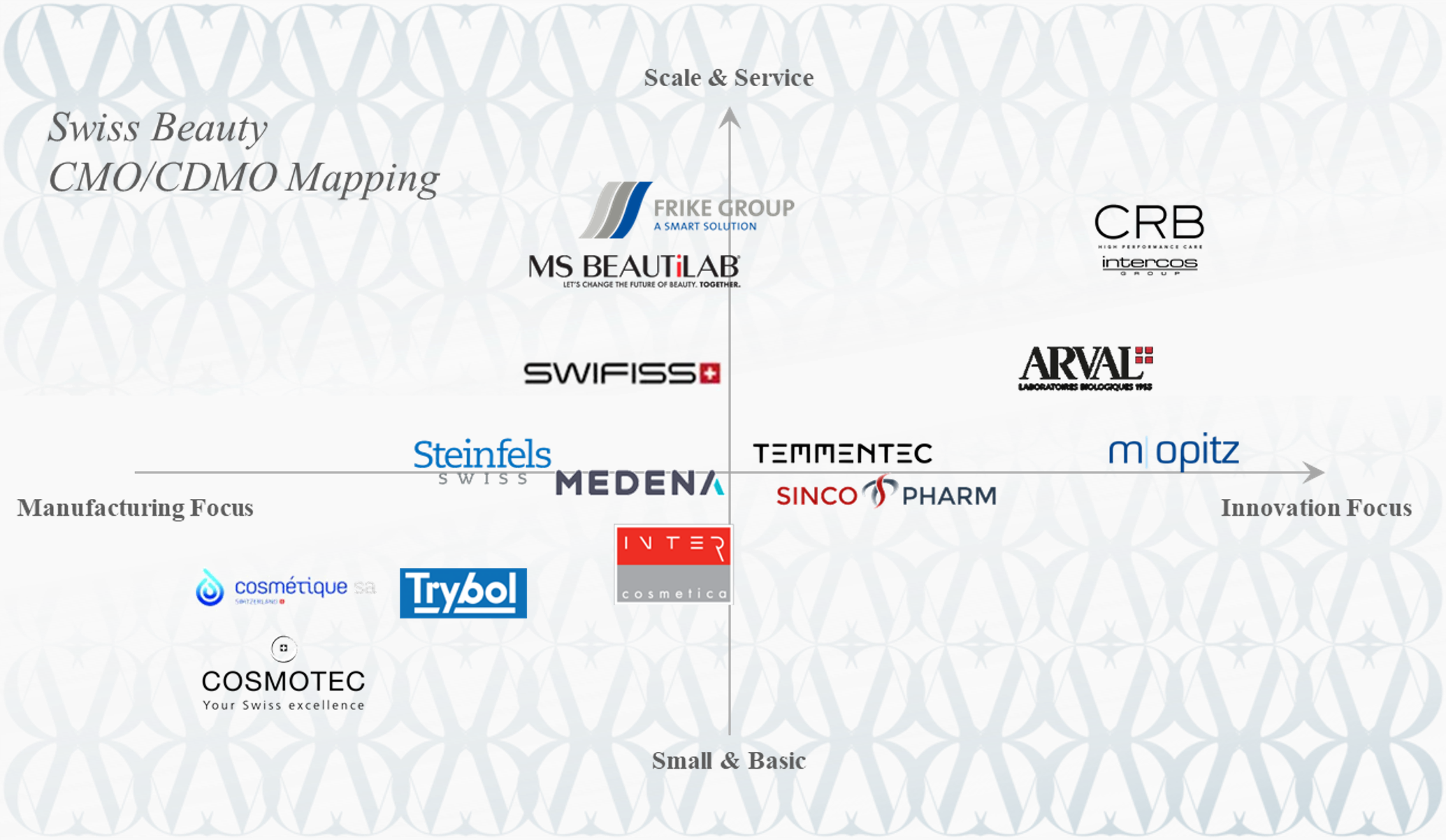
The Swiss contract beauty manufacturing space is not a monolith. It spans everything from century-old family manufacturers to pharma-lean CDMOs, from single-site execution shops to multi-category European platforms with Swiss roots. Understanding the differences matters, because the choice of manufacturing partner has a direct and lasting impact on a brand's ability to innovate, scale, and sustain margin.
CRB S.A. (Centre de Recherches Biocosmétiques), based in Puidoux, is arguably the most internationally prominent player in the Swiss CMO space. Founded in 1983 and now part of the Intercos Group, CRB combines Swiss manufacturing credibility with the R&D infrastructure, actives expertise, and industrial scale of one of the world's leading cosmetic ingredient and development companies. For large international brands that require both Swiss-origin positioning and access to cutting-edge formulation science, CRB is a natural first conversation. Its integration into Intercos gives it capabilities that no standalone Swiss CMO can easily match on pure R&D depth. The trade-off is that smaller brands may find the minimum volumes and commercial complexity of a group-level partner challenging to navigate.
Temmentec AG, founded in 1916 and based in Sumiswald, represents a different model entirely. It is one of Switzerland's longest-established contract manufacturers, and it operates a genuinely end-to-end model: formulation, manufacturing, filling, packaging, quality control, and logistics, all under one roof, all in Switzerland. That last point matters for Swissness compliance, since every stage of value creation remains onshore. Temmentec serves premium, natural, and niche brands with a mix of luxury skincare, hair care, sun care, and personal care formats. Its flexibility across batch sizes, from startups to enterprises, makes it accessible to a wider range of clients than some of the more industrial operators.
MS BeautiLAB, part of the MarvinPac Group and established in 1964, extends the Swiss CMO concept toward something more pan-European. With primary operations in France and a Swiss presence among other European sites, MS BeautiLAB trades some Swiss manufacturing purity for broader scale and service sophistication. Its model integrates strategic marketing support, trend intelligence, and sustainability frameworks alongside multi-category manufacturing across skincare, makeup, and haircare. For brands that need a partner capable of thinking commercially as well as scientifically, MS BeautiLAB offers a compelling proposition, even if it sits further from the pure "Swiss made" anchor than some competitors.
Intercosmetica Neuchâtel SA occupies a more focused and agile position. It targets small to mid-sized brands that value Swiss-made production, regulatory reliability, and operational proximity over industrial scale. Its offering covers formulation, manufacturing, filling, packaging, and regulatory support, with particular strength in flexible private label programs. The appeal here is straightforwardness: a nimble partner that can execute efficiently without the overhead of a large group structure.
Cosmotec SA sits at the execution-focused end of the spectrum. It is best understood as a pragmatic industrial subcontractor rather than a strategic development partner. Brands that already own their formulations and need reliable, cost-effective Swiss production at moderate batch sizes will find a dependable partner here. Cosmotec does not drive innovation, and it does not need to. Its role is fidelity to specification, delivered with Swiss quality standards and operational consistency.
Sincopharm SA occupies a distinct niche altogether, bridging the worlds of cosmetics and pharmaceuticals. The company specializes in dermo cosmetic, medical device, and healthcare-adjacent products, operating with pharmaceutical-grade quality systems. Its clients are brands that require validated processes, rigorous documentation, and a manufacturing environment built for compliance rather than volume. In a market where dermo cosmetics and clinical skincare are among the fastest-growing segments, Sincopharm's positioning is timely. It serves a client who needs a Swiss CMO that thinks like a pharma CDMO.
FRIKE GROUP, the probably the largest independent contract manufacturer in Switzerland, operates across five production facilities and covers cosmetics, pharmaceuticals, and chemicals under one corporate umbrella. Its neutral CMO status, meaning it has no proprietary brands competing with client products, is a meaningful commercial differentiator. FRIKE's technical breadth, which spans aerosol processing, powder technologies, and standard liquid and semi-liquid formats, makes it well-suited to mid-to-large brands with diverse or technically demanding portfolios. The combination of Swiss credibility and genuine industrial breadth at an independent scale is not easy to find.
Medena AG is a mid-tier Swiss CMO with comprehensive execution capabilities across hair, skin, sun, oral, and body care formulations. Its ISO 13485 certification for medical products, alongside cosmetic GMP credentials, gives it crossover appeal for brands operating at the intersection of beauty and medical devices. The company's strength lies in reliable execution and strong regulatory support, particularly for brands targeting international markets with complex registration requirements.
Steinfels Swiss, part of the Coop Group and operating since 1832, brings a sustainability dimension that few Swiss manufacturers can credibly claim at scale. Based in Winterthur, the company has built a reputation for environmentally oriented formulations and processes that is supported by genuine heritage rather than recent positioning. For brands for whom ecological credibility is central to their identity, Steinfels offers a combination of longevity, scale, and sustainability conviction that is genuinely distinctive.
Swifiss AG, based in Urnäsch, positions itself as a premium full-service cosmetic manufacturer for bespoke projects. Its model emphasizes Swiss craft, flexible textures and fragrances, and a concept-to-market capability that suits brands looking for differentiated, individually developed products rather than catalog formulations. Swifiss sits between the niche formulation partner and the structured CMO, a useful position for premium brand projects that require both creative flexibility and production rigor.
Trybol AG, founded in 1900 and active as both a brand and a private label manufacturer, serves the smaller end of the market with in-house formulation, filling, and packaging at batch sizes starting around 10 kilograms. Over 120 years of cosmetic experience is a meaningful credential, and Trybol's accessibility to small-batch, niche projects makes it a useful entry point for emerging brands building their first Swiss-made product lines.
Cosmétique SA Worben and Celker SA round out the execution-focused tier, serving as pragmatic manufacturing partners for brands that own their formulas and need reliable, Swiss-anchored production without the overhead of a strategic development relationship. Both prioritize operational fidelity and quality compliance over R&D or concept creation.
M. Optiz & Co AG represents the pharmaceutical-lean end of the cosmetic manufacturing spectrum, bringing high regulatory discipline and controlled production environments to technically demanding dermo-cosmetic formulations. Its positioning is closer to a specialty CDMO than a conventional beauty CMO, making it most relevant for brands at the clinical or therapeutic edge of the skincare market.
ARVAL | Laboratoires Biologiques ARVAL SA, founded in 1952 and based in Conthey in the Valais canton at the foot of the Swiss Alps, is one of the most quietly compelling operators in the Swiss CMO landscape. Over more than 70 years, the company has developed and manufactured cosmetics for internationally recognized prestige brands, including Valmont, one of the most respected luxury skincare names in the world. That relationship is telling: Valmont has cited ARVAL specifically for combining the highest quality with genuine manufacturing flexibility, a pairing that most CMOs resolve by quietly compromising on one dimension. ARVAL scientific orientation goes beyond execution: the company actively invests in formulation research and has undertaken foundational sustainability reformulation work across core product categories. As a fully independent, family-owned business with no group agenda mediating its client relationships, and with a proven international reach spanning Asia including China, Hong Kong, and Japan, ARVAL occupies a distinct position in the Swiss CMO market: a manufacturer that combines prestige credentials, scientific depth, operational flexibility, and a forward-facing sustainability platform under one independent roof.
Reading the Landscape Strategically