
CARRARA Advisory monitors a panel of 13 companies to assess the direction of the global beauty and personal care sector. The panel spans different categories, geographies, distribution models and business scales. It is designed to provide a consistent view of company performance and competitive developments, rather than to reproduce the exact weighting of the global market.
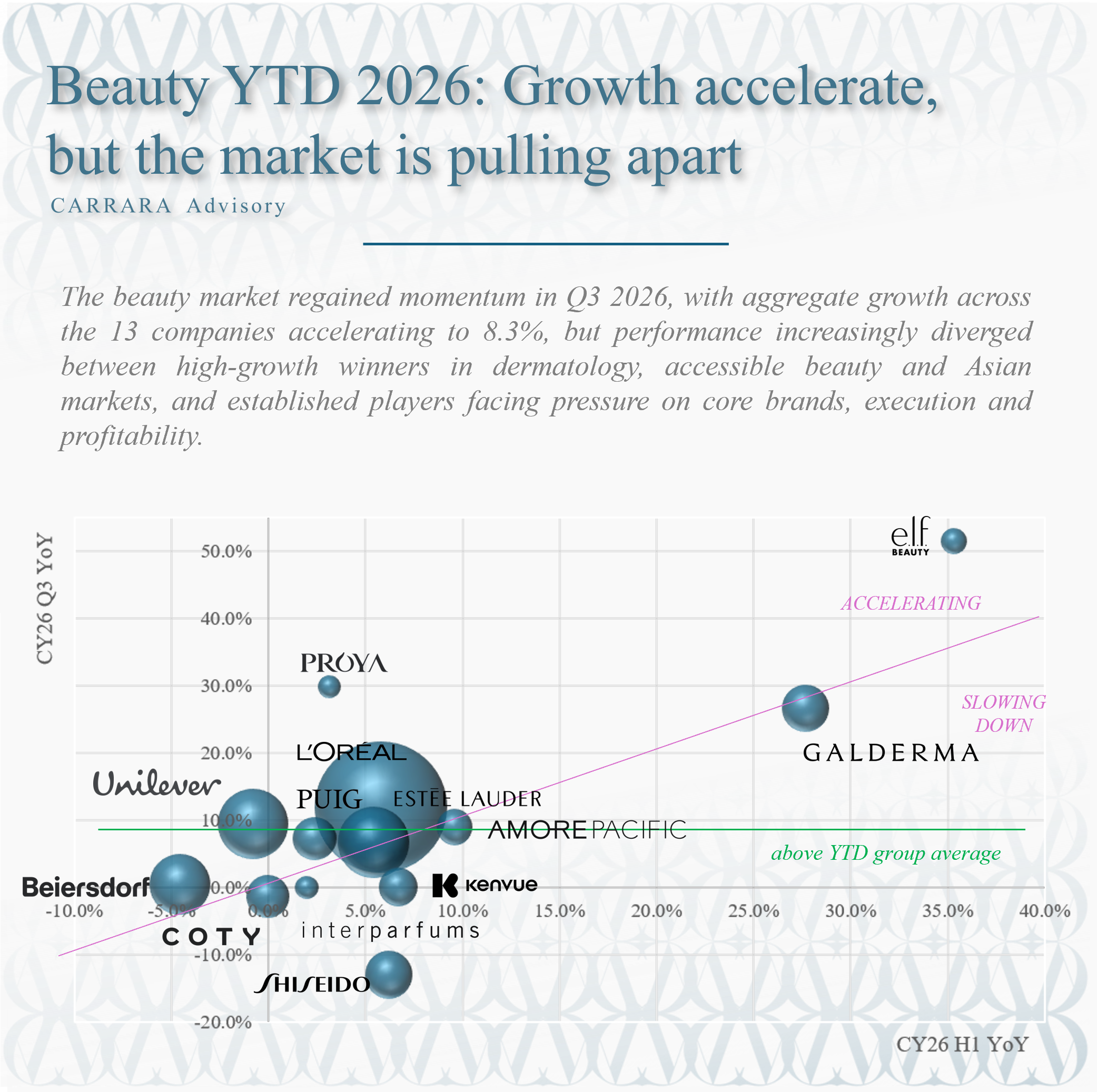
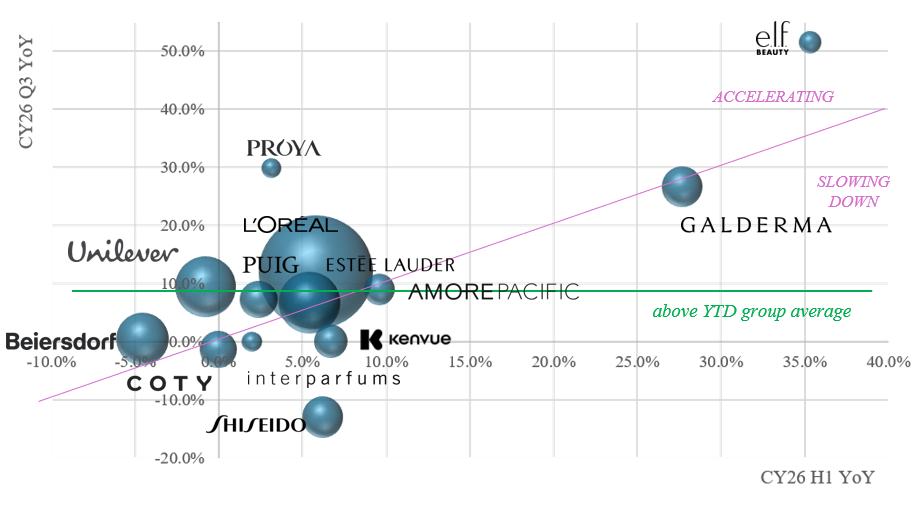
This quarter, the central message is clear. The panel's reported aggregate growth accelerated from 4.9% in the first half of 2026 to 8.3% in Q3. The improvement is encouraging, but it does not describe a uniform recovery. A small number of companies are growing at exceptional rates, several established groups are regaining momentum, and others remain flat or are contracting. The gap between these outcomes is becoming one of the defining characteristics of the market.
Executive perspective
The strongest performances continue to come from businesses with clear positions in attractive categories. E.L.F. Beauty accelerated from 35.3% growth in H1 to 51.4% in Q3. PROYA moved from 3.1% to 29.8%, while Galderma sustained growth of 27.7% and 26.6% across the two periods. These results are materially ahead of most of the panel and point to the opportunities available to companies with strong consumer propositions, focused portfolios, relevant innovation and strategic M&A operation.
The recovery among larger businesses is also worth noting. L'Oréal accelerated from 5.8% to 11.9%, Estée Lauder improved from 5.4% to 6.7%, and Unilever moved from a 0.8% decline to 9.4% growth. Puig also improved, reaching 7.2% in Q3. These developments show that established groups retain significant assets and can regain momentum when brand investment, product relevance and execution come together.
At the same time, the picture remains uneven. Shiseido's panel growth moved from 6.2% to a 13.0% contraction. Kenvue slowed from 6.7% to 0.1%, Beiersdorf moved only marginally into positive territory, Coty remained negative and Interparfums was flat. These are different businesses facing different issues, but the common point is that scale and heritage do not automatically translate into growth.
Three broader themes emerge. First, category exposure matters. Dermatology, science led skincare, fragrance and selected value oriented propositions are attracting demand. Second, the route to the consumer is changing. Digital discovery, social commerce and specialist communities increasingly influence brand choice, while traditional distribution remains important but needs to earn its place. Third, growth quality matters as much as growth rate. Revenue gains must be understood in terms of volume, price, mix, acquisitions, currency, channel inventory and profitability.
For boards, investors and management teams, the question is no longer simply which companies are growing fastest. It is which businesses are building repeatable advantages, which are buying growth, which are restoring the fundamentals of their core portfolios, and which have a credible plan to translate market opportunity into sustainable enterprise value.
1. A stronger quarter, with growth concentrated among a few companies
The move in the panel's reported aggregate growth from 4.9% in H1 to 8.3% in Q3 is a meaningful acceleration. It suggests that the sector entered the second half of the year with better momentum than the first six months had indicated. Yet the headline figure needs to be read with care. It combines companies operating in very different markets and categories, and it is influenced by the size and growth profile of individual businesses. It should not be interpreted as a direct measure of the growth of the global beauty market.
The dispersion within the panel is more revealing. E.L.F. Beauty, PROYA and Galderma each recorded Q3 growth above 25%. At the other end, Shiseido contracted by 13.0%, Coty by 1.4%, and Interparfums was flat. Kenvue and Beiersdorf were close to break even. The difference between the strongest and weakest Q3 performers is therefore more than 60 percentage points. Such a wide range is not a normal variation around a single market trend. It indicates that company specific factors are having a major influence on reported performance.
The pattern also challenges the idea that the beauty market can be described through a simple prestige versus mass distinction. E.L.F. Beauty is a value oriented cosmetics business. Galderma is positioned around dermatology, prescription treatments, injectables and science backed skincare. PROYA is a Chinese beauty group with an expanding portfolio and international ambitions. Their business models are very different, yet all are delivering strong growth. The common denominator is not price positioning. It is a clear proposition, an identifiable consumer need and the ability to execute.
Conversely, companies with broad portfolios and established distribution are not necessarily protected from weak demand or execution issues. Some are navigating restructuring, changes in channel inventory, portfolio transitions or regional exposure. Others may be growing in selected categories while the wider group remains under pressure. A group level result can therefore conceal both pockets of strength and businesses requiring more fundamental attention.
For strategic decision makers, the first implication is to move beyond the headline growth rate. Company performance should be assessed at the level of category, brand, geography and channel. The second is to distinguish between temporary movements and structural changes. A single quarter can be affected by launch timing, retailer orders or comparison effects. A sequence of quarters, supported by market share and profitability data, is a much stronger basis for judging whether a business is gaining ground.
2. Dermatology and science led beauty are creating a powerful growth platform
Galderma remains one of the most compelling businesses in the panel. Its growth was 27.7% in H1 and 26.6% in Q3, showing that the result is not dependent on a single exceptional quarter. The company's own announcement reported first nine month sales of USD 4.765 billion, up 25.1% at constant currency. Growth was broad across geographies and product categories, with particularly strong performance in Therapeutic Dermatology, Dermatological Skincare and Neuromodulators.
The detail matters. Galderma reported constant currency growth of 64.4% in Therapeutic Dermatology, 16.2% in Dermatological Skincare and 13.2% in Injectable Aesthetics for the first nine months. The company attributed growth primarily to volume, complemented by favorable mix. This is a stronger growth profile than one driven mainly by price increases or the acquisition of additional revenue. It reflects demand across a portfolio that spans medical treatment, professional procedures and consumer skincare.
The broader opportunity is the growing overlap between beauty, health and wellness. Consumers are increasingly looking for products and services that address a specific concern and deliver visible results. Dermatologist recommendation, clinical evidence, active ingredients and professional endorsement can strengthen credibility and reduce the extent to which a brand competes solely on image or advertising. This creates opportunities for businesses that can combine scientific capability with consumer communication and effective routes to market.
Beiersdorf provides another example of this category shift. Its Q3 company announcement reported 10.6% organic growth in Derma, with Eucerin and Aquaphor outperforming the market. La Prairie also accelerated, with 8.5% organic growth in the quarter, supported by China. Yet the group's consumer business remained under pressure, with NIVEA reporting a 4.9% organic decline in Q3. The contrast is instructive. Strong brands and attractive categories can coexist with a weaker group result when the largest parts of a portfolio are not performing.
These developments should not be reduced to the assertion that science led skincare is automatically a winning formula. Clinical language can become a commodity, and consumers are increasingly able to compare ingredients, claims and prices. Credibility has to be earned through product performance, substantiated claims, consistent experience and professional trust. The ability to translate scientific differentiation into a distinctive and accessible consumer proposition is the real source of advantage.
For companies considering entry or expansion in this space, the strategic choices are significant. Building a credible dermocosmetics business requires more than launching a serum with a clinical sounding name. It requires product development, regulatory discipline, evidence, claims management, channel selection and, where relevant, relationships with dermatologists and other professionals. Acquisitions can accelerate access to these capabilities, but integration must preserve the expertise and credibility that made the asset attractive in the first place.
3. Established leaders are recovering, but the nature of the recovery differs
L'Oréal's acceleration is important because of its scale. The panel records growth of 5.8% in H1 and 11.9% in Q3. The company's own Q3 release reported 11.9% growth on a reported basis, 7.2% like for like growth in the quarter and 6.9% like for like growth for the first nine months. The difference between reported and like for like performance is material. The company also reported a positive 2.0% contribution from changes in the scope of consolidation and a negative 1.2% currency impact over the nine month period.
The operating detail is more useful than the headline alone. L'Oréal reported growth across all four divisions in the first nine months, with particularly strong performances in Professional Products and Dermatological Beauty. Fragrance and haircare were important growth drivers, while skincare accelerated. E-commerce grew by around 17%, ahead of the online market. The company also highlighted growth across regions, led by SAPMENA and Sub Saharan Africa, alongside positive momentum in developed markets. This breadth suggests that the group is benefiting from a combination of category exposure, brand strength and distribution execution.
Estée Lauder's improvement is another development to watch. The panel shows growth moving from 5.4% in H1 to 6.7% in Q3. The company's fiscal 2027 first quarter results, published in November, described sales growth across nearly all product categories and every geographic region. It also raised its full year outlook for sales, margin and earnings. The company presented the quarter as progress in its Beauty Reimagined program, with stronger profitability and improved execution.
The importance of Estée Lauder's results goes beyond the reported growth rate. The group has been working through a difficult period involving uneven regional demand, channel and inventory adjustments, organizational changes and the need to restore profitability. A recovery in sales is necessary, but the more demanding test is whether the company can sustain consumer demand while rebuilding margins, improving productivity and allocating marketing investment more effectively. The quality of the recovery will be determined by the relationship between sales, gross margin, operating expenses and cash generation.
Unilever's panel result moved from a 0.8% decline in H1 to 9.4% growth in Q3. Its own Q3 trading statement reported underlying sales growth of 5.2%, with underlying volume growth of 2.9% and price growth of 2.3%. Turnover increased by 6.7%, reflecting operational performance, acquisitions and currency. The panel figure should therefore not be compared directly with the company's underlying sales measure. The official results nevertheless indicate improving volume delivery, particularly across its Power Brands and Personal Care and Home Care businesses.
Taken together, these developments show that the larger groups are not standing still. Their scale provides access to research, marketing, distribution, data and capital. It also creates organizational complexity and makes it harder to redirect resources quickly. The strongest incumbents are those that use scale to reinforce distinctive brands and capabilities, rather than allowing the organization itself to become a source of friction.
4. Asia is not a single growth story
The results of Shiseido, Amorepacific and PROYA illustrate why regional generalizations are increasingly unhelpful. In the panel, Shiseido moved from 6.2% growth in H1 to a 13.0% contraction in Q3. Amorepacific remained relatively stable, at 9.6% and 8.9%. PROYA accelerated from 3.1% to 29.8%. These are three distinct outcomes within the same broad regional context.
Amorepacific's own Q3 announcement reported revenue growth of 8.9% and operating profit growth of 24.7%. The company highlighted stronger profitability in Korea and growth across its multi brand model in North America, Japan, India and other markets. AESTURA and INNISFREE were among the brands contributing to overseas performance, while the group also described progress in derma and haircare. The result is notable because revenue growth was accompanied by stronger operating profit, suggesting improvement in both commercial performance and operating leverage.
PROYA's Q3 acceleration deserves a more careful reading. Its reported revenue increased 29.8% in the quarter, but Business of Fashion reported that higher marketing expenditure contributed to a 46.7% decline in total profit for the quarter. The company's first nine month revenue growth was 7.46%, materially below the Q3 rate. This is an important distinction. A sharp quarterly acceleration can signal strong demand, but it can also reflect launch timing, promotional activity or investment that has not yet translated into profit.
PROYA's international ambitions add another dimension. The company has been investing in overseas expansion and building the infrastructure to support its brands in new markets. This creates an opportunity to extend successful domestic propositions, but international growth is rarely a simple replication exercise. Brand awareness, consumer preferences, retail economics, regulatory requirements and competitive intensity differ by market. Distribution can be secured faster than sustainable consumer demand can be built.
Shiseido requires a separate qualification. Its November 2026 results briefing reported a return to year to date like for like sales growth of 1%, with Q3 like for like growth of 3%. That is not consistent with the 13.0% contraction shown in the panel. The two measures appear to use different reporting bases, periods or currency treatments and should not be reconciled without confirming the panel methodology. The company also reported growth led by the SHISEIDO and Clé de Peau Beauté brands, improving profitability and cash generation, and an upward revision to its full year profit outlook. The panel figure remains as supplied, but the difference is a clear reminder of why definitions matter.
The strategic lesson is not that one country or region is winning while another is losing. The more relevant question is whether each company has a proposition that fits the consumer, channel and competitive structure of the markets in which it operates. A strong local brand may travel internationally, but it needs adaptation and investment. A global brand may have broad awareness, but still need to rebuild local relevance. Companies should evaluate their Asian exposure by brand and route to market, not by regional labels alone.
5. Fragrance remains attractive, but performance is increasingly brand specific
Fragrance continues to offer an important growth opportunity within beauty. McKinsey's 2026 analysis expects fragrance to be the most consistently growing of the four core beauty categories through 2030 and notes that it has become larger than color cosmetics. Demand is supported by prestige and niche scents, designer launches and the expansion of more accessible premium propositions. Consumers are also experimenting with layering and using different fragrances for different occasions.
The category benefits from a particular combination of emotional appeal, gifting relevance, collectability and relatively frequent product launches. Fragrance can also provide fashion and luxury brands with a route into beauty that does not require the same technical infrastructure as skincare. However, the attractiveness of the category can lead to crowded launch calendars, rising marketing costs and a dependence on a small number of successful franchises. The economics of licensing and distribution need to be considered alongside consumer demand.
Within the panel, Puig improved from 2.4% growth in H1 to 7.2% in Q3. Interparfums moved from 2.0% to flat performance. Interparfums' own third quarter release reported flat sales of USD 430 million in the quarter and nine month sales growth of 1% to USD 1.115 billion. Gross margin increased by 360 basis points in Q3, while operating income rose 9%. The contrast between flat revenue and improved gross margin demonstrates why sales growth alone does not tell the whole story.
Coty's panel figure was negative 1.4% in Q3. Its own fiscal first quarter release reported a 1% decline in reported revenue and a 2% decline on a like for like basis. At the same time, Coty said its six largest Prestige brands had returned to like for like growth, supported by concentrated investment and a stronger performance in several key markets. The company also extended its Marc Jacobs license for 40 years. This points to the importance of franchise strength and long term brand partnerships in a category where the value of a portfolio is often concentrated in a limited number of names.
The strategic implication is that fragrance should not be treated as a single growth pool. The performance of a portfolio depends on the quality of its licenses, the strength of its hero products, the timing and productivity of launches, distribution, geographic mix and the ability to sustain consumer interest after the initial campaign. Brand owners should be disciplined about the number of launches they support and the level of investment required to build each one.
6. The middle of the market faces a more demanding test
Several companies in the panel are not in crisis, but their performance is not yet convincing. Beiersdorf moved from a 4.5% contraction in H1 to 0.4% growth in Q3. Kenvue slowed from 6.7% to 0.1%. Coty remained negative, while Interparfums was flat. These results suggest that a number of established businesses are still searching for a clear and repeatable growth engine.
Beiersdorf's results show how different businesses within one group can move in opposite directions. Derma and La Prairie performed well, while NIVEA remained under pressure. The company identified temporary sell in headwinds and trade destocking affecting NIVEA, while also describing its turnaround plan, innovation pipeline and value for money positioning. This is a familiar challenge for large consumer businesses. The group may have strong assets, but the performance of the largest brands determines whether specialist growth can move the total result.
Kenvue's official Q3 announcement also provides a useful contrast with the panel figure. The company reported net sales growth of 3.2% and organic sales growth of 2.9%, its fourth consecutive quarter of net and organic growth. However, its Skin Health and Beauty segment reported an organic sales decline of 0.5%, while Self Care grew 5.4% organically. The panel's 0.1% Q3 figure is therefore not directly comparable with the company's total net sales growth. The company also reported improving margins and cash generation, while preparing for its combination with Kimberly Clark.
This illustrates why the label beauty and personal care needs to be used carefully. Kenvue is a diversified consumer health business. Its skin health and beauty segment is only one part of the portfolio. Its group result can be supported by Self Care or Essential Health even when beauty related sales are flat. The same principle applies to conglomerates with non beauty businesses. Panel comparisons are useful, but they need to be interpreted in the context of each company's portfolio.
The companies in this middle group have different strategic priorities. Some need to restore the performance of large legacy brands. Others need to improve the productivity of marketing expenditure, simplify their portfolios or address channel economics. For investors, the key is to distinguish a temporary period of adjustment from a business model that is losing relevance. For management teams, the task is to identify the few changes that will have the greatest impact on the consumer proposition and operating model.
7. The consumer is becoming more selective, and value is being redefined
The sector's resilience should not be confused with unlimited pricing power. McKinsey's 2026 beauty outlook expects global beauty to grow by around 5% annually through 2030, but it also points to consumer price sensitivity and selective trading down, particularly in Europe. After several years in which price increases and premiumization contributed materially to growth, volume is expected to play a larger role. This has consequences for both premium and mass market companies.
Value is no longer defined only by the lowest price. Consumers can trade down to a lower priced product if they believe it delivers credible results. They can also trade up for a product that offers a clear emotional, sensory or performance benefit. The middle ground is more exposed when the proposition is not distinctive enough to justify a premium and not accessible enough to compete on value. This helps explain why dermatologist backed skincare at accessible prices can challenge expensive skincare, while certain premium fragrance propositions continue to attract demand.
The shift creates an opportunity for companies that understand the consumer's reason to buy. A product can win because it solves a functional problem, provides confidence, expresses identity, offers a moment of pleasure or forms part of a daily routine. The strongest brands connect these motivations to a clear product benefit and a consistent experience. Broad claims about quality or innovation are no longer enough. Consumers have access to reviews, ingredient information, creator commentary and competing products within seconds.
Price architecture deserves renewed attention. A portfolio should offer clear entry points, core products and premium options, with each price level supported by a reason to exist. Excessive price gaps can push consumers toward competitors. Too many similar products can confuse the proposition and increase complexity. A good architecture allows a brand to recruit consumers, build usage and trade customers up over time without undermining its credibility.
Management teams should also examine the relationship between price, volume and mix. Revenue growth supported by price increases may be attractive in the short term, but it can weaken recruitment if consumers do not perceive additional value. Volume growth can build market share, but may be uneconomic if it depends on heavy discounting. The objective is profitable consumer recruitment, supported by a proposition that remains relevant at the point of purchase and throughout product use.
8. Digital discovery is changing the economics of brand building
Digital is no longer simply another sales channel. It increasingly shapes how consumers discover, evaluate and develop preferences for beauty brands. McKinsey's 2026 research describes a shift from traditional store led discovery toward social commerce, digital marketplaces and emerging forms of agentic commerce. It estimates that e-commerce already represents the largest share of global beauty sales by channel and expects it to account for most of the sector's sales growth through 2030.
This does not mean that physical retail is becoming irrelevant. Beauty remains a category in which consumers value sampling, advice, service and the physical experience of a brand. Stores can create discovery, trial and loyalty, while digital channels provide convenience, content, replenishment and access to a broader range. The competitive advantage increasingly belongs to companies that connect these experiences rather than treating online and offline as separate businesses.
The rise of creator led discovery also changes the relationship between brand owners and consumers. A brand can gain visibility quickly through a creator or community, but attention is not the same as repeat purchase. The commercial test is whether awareness converts into trial, whether trial converts into repeat, and whether the economics remain attractive after platform fees, creator compensation, discounts and fulfilment costs. Viral success can create a spike in demand, but it can also create inventory and service challenges if the operating model is not ready.
E.L.F. Beauty illustrates the power of a clear proposition and strong consumer engagement. The company reported 51% Q2 fiscal 2027 net sales growth to USD 520.8 million and raised its full year sales outlook. It highlighted strength across retail and e-commerce in the United States and internationally. The Rhode acquisition contributed to the reported results, so it is important to separate the acquired contribution from the performance of the existing business. Even with that qualification, the result demonstrates the value of brand relevance, community engagement and a proposition that can travel across channels.
Digital capability should therefore be viewed as a commercial operating capability. It requires content production, consumer insight, measurement, retail media discipline, customer relationship management, data governance and the ability to coordinate demand with supply. The objective is not to publish more content or spend more on social platforms. It is to improve the efficiency with which the business attracts, converts and retains consumers.
9. Growth quality, acquisitions and the discipline of measurement
The panel is designed to identify performance trends, but reported revenue growth is only the starting point. Company announcements use different measures, including reported sales, organic growth, like for like growth and constant currency growth. Fiscal calendars also differ. Some companies include acquisitions and changes in consolidation scope in their reported figures, while others provide additional measures that exclude these effects. These differences matter when comparing businesses.
L'Oréal is a clear example. Its 11.9% Q3 reported growth was higher than its 7.2% like for like growth. The company explained that changes in the scope of consolidation added 2.0% to nine month reported growth, while currency movements reduced it by 1.2%. Unilever's 9.4% panel figure should also be read alongside its official 5.2% underlying sales growth and 6.7% turnover increase. Neither figure is inherently more useful than the other, but they answer different questions.
E.L.F. Beauty's reported growth includes the contribution of Rhode. Galderma's constant currency growth was supported by strong volume and favorable mix. PROYA's quarterly revenue acceleration came alongside higher marketing costs and lower quarterly profit. Interparfums reported flat quarterly revenue but higher gross margin. Each example demonstrates a different relationship between top line performance and the economics behind it.
Acquisitions can accelerate entry into a category, add brands, bring capabilities or provide access to new markets. They can also create complexity, increase leverage and distract management. The purchase price is only the beginning. Value is created through the quality of the asset, the strategic fit, the ability to retain talent, the integration of systems and operations, and the commercial opportunities that can be realized after closing.
For beauty businesses, integration needs particular care. Brand identity, product development culture, founder involvement, creative talent and consumer communities can be central to the value of an acquired asset. A conventional integration program that focuses too heavily on cost removal can damage the very characteristics that made the business attractive. Equally, leaving every process untouched can prevent the group from capturing purchasing, distribution, data and operational benefits. The right model protects what differentiates the brand while integrating the capabilities that improve scale and performance.
Boards and investors should ask whether reported growth is accompanied by market share gains, healthy gross margin, disciplined customer acquisition costs, improving cash conversion and a credible return on invested capital. These measures help distinguish growth that creates value from growth that consumes capital.
10. What the results mean for brand owners and management teams
Start with the consumer and category. The strongest businesses have a clear understanding of the need they serve and the category economics in which they compete. Portfolio reviews should begin with consumer relevance, repeat purchase, market growth and competitive differentiation, rather than historical brand size alone.
Make innovation commercially accountable. Innovation should be measured by incremental sales, recruitment, repeat purchase, margin and the effect on the wider portfolio. Launch volume is not a measure of innovation productivity. Companies should be prepared to stop launches that add complexity without building meaningful demand.
Give local teams the right freedom. Regional performance is increasingly differentiated. Global brand consistency matters, but local teams need the ability to adapt channel mix, communication, price architecture and activation to local consumer behavior. Governance should protect the brand while allowing decisions to be made close to the market.
Treat channel strategy as a portfolio decision. The role of department stores, specialty retail, pharmacies, marketplaces, social commerce and direct to consumer differs by category and brand. Distribution should be selected on the basis of consumer access, brand experience, economics and data ownership, not simply reach.
Build the operating model around the strategy. A business cannot deliver faster innovation or better local execution if decision rights, incentives, systems and capabilities are designed for a different era. Organisation design, talent, planning processes and performance management need to reinforce the commercial priorities.
Measure value creation beyond revenue. Growth should be assessed alongside margin, working capital, cash flow and return on invested capital. This is particularly important for businesses expanding through acquisitions, international launches or high levels of marketing investment.
11. The CARRARA Advisory perspective: Enter, Expand and Exit
The results reinforce the relevance of a disciplined approach to building beauty businesses. The opportunity is substantial, but attractive categories and strong consumer demand do not remove the need for sound business fundamentals. The choices made at entry shape the options available during expansion and ultimately influence the value that can be realized through a transaction or long term ownership.
Enter. For fashion, luxury and lifestyle brands considering beauty, the first decision is not which license to sign or which product to launch. It is whether the brand has permission to participate in the category and what consumer need it can credibly address. The partner model, product architecture, pricing, distribution and investment requirements should be established before launch. A successful entry creates a platform for repeatable growth. A poorly structured entry can limit the brand, weaken economics and make future expansion difficult.
Expand. For established beauty businesses, the challenge is to identify the most productive sources of growth. This may involve improving the performance of existing brands, entering new markets, extending categories, developing new channels or acquiring complementary businesses. The panel shows that growth can come from very different sources, but the quality of execution determines whether momentum becomes durable. Expansion should be supported by a clear value creation plan, measurable milestones and an operating model capable of delivering the strategy.
Exit. For shareholders and investors, preparation for a transaction should begin well before a sale process. A valuable beauty asset needs a clear equity story, reliable financial information, defensible brand positioning, a credible management team and a growth plan that a new owner can execute. The distinction between organic growth and acquired revenue, the quality of margins, the strength of distribution and the resilience of consumer demand all influence buyer confidence and valuation.
These phases are connected. A brand that enters a market without understanding its economics may find that expansion requires repeated discounting. A business that expands through acquisitions without integration discipline may become harder to manage and less attractive to buyers. A company that waits until a transaction is imminent to address its operating weaknesses may have limited time to demonstrate improvement. Enterprise value is built through a sequence of decisions, not created at the moment of sale.
12. Priorities to watch in the final quarter and into 2027
The final quarter will help establish whether the acceleration in the panel is sustainable. For E.L.F. Beauty, the key question is how much of the growth can be maintained as the Rhode contribution and comparison base evolve, and whether profitability keeps pace with sales. For Galderma, attention will turn to the continuation of growth across its three categories, the commercial performance of new treatments and the ability to sustain market share while expanding its geographic reach.
PROYA will need to show that its international expansion and marketing investment can translate into profitable growth. Its Q3 revenue acceleration is impressive, but the profit decline reported alongside it makes the return on commercial investment an important measure. Amorepacific will be judged on its ability to extend its multi brand model across markets while maintaining the stronger profitability achieved in Q3.
For L'Oréal and Estée Lauder, the priority is to maintain the breadth of the recovery. L'Oréal's results suggest strength across divisions and regions, while Estée Lauder has raised its outlook after a stronger quarter. Both will need to demonstrate that growth is supported by consumer demand, productive innovation and healthy margins. For Unilever, the focus will be on sustaining volume growth and the contribution of its Power Brands.
Shiseido's results need to be followed using a consistent reporting basis, given the difference between the panel figure and the company's own like for like disclosure. Beiersdorf will need to demonstrate that the strength of Derma and La Prairie can increasingly offset pressure in NIVEA. Kenvue's pending combination with Kimberly Clark introduces a further strategic dimension, with integration and portfolio priorities likely to influence the longer term growth profile.
In fragrance, the contrast between Puig, Coty and Interparfums should be monitored through brand level performance, launch productivity and margin development. The category remains attractive, but strong consumer interest does not guarantee that every portfolio or license will benefit equally. The ability to build enduring franchises will matter more than the number of launches.
CARRARA Advisory conclusion
The third quarter confirms that beauty remains a sector with meaningful growth opportunities. It also confirms that those opportunities are increasingly selective. Companies with distinctive propositions, relevant innovation and effective execution are gaining ground. Others are dealing with portfolio pressure, regional weakness, channel changes or the consequences of operating models that have not adapted quickly enough.
The strongest businesses in the panel are not all competing in the same category or at the same price point. What they share is a clear reason for consumers to choose them and the capability to convert that preference into sales. The strongest established groups demonstrate that scale remains valuable when it is used to support innovation, distribution and brand building. The weaker results show that scale can also conceal complexity and slow decision making.
The strategic divide is therefore not simply between prestige and mass, global and local, or large and small. It is between businesses that can turn their assets into relevance, profitable growth and enterprise value, and those that cannot. The next phase of competition will reward companies that understand their consumers, make disciplined choices about where to compete, and align their organization and investment behind those choices.
For the remainder of 2026 and into 2027, CARRARA Advisory will continue to monitor the durability of growth among the leading specialists, the breadth of the recovery among global incumbents, the performance of Asian beauty groups and the ability of companies under pressure to restore sustainable momentum. The numbers show where performance is moving. The more important task is to understand why, and what management teams should do next.
Selected references
CARRARA Advisory, corporate positioning and E3volution framework
https://carrara-advisory.com/
McKinsey & Company, From aisle to algorithm: The beauty categories, channels, and concepts shaping 2030 growth, 18 June 2026
https://www.mckinsey.com/industries/consumer-packaged-goods/our-insights/state-of-beauty
Euromonitor International, The World Market for Beauty and Personal Care, September 2026
https://www.euromonitor.com/the-world-market-for-beauty-and-personal-care/report
L'Oréal, Sales at 30 September 2026, 22 October 2026
https://www.loreal.com/en/press-release/finance/sales-at-30-september-2026/
Galderma, First nine months 2026 results and revised guidance, 22 October 2026
https://www.galderma.com/news/galderma-reports-q3-2026-results-and-raises-full-year-guidance
The Estée Lauder Companies, Fiscal 2027 First Quarter Results, 2 November 2026
https://www.elcompanies.com/en/news-and-media/newsroom/press-releases/2026/11-02-2026-110046663
Unilever, Q3 2026 Trading Statement, 28 October 2026
https://www.unilever.com/investors/results-events/results-events-webcasts/latest-results/
e.l.f. Beauty, Second Quarter Fiscal 2027 Results, 4 November 2026
https://www.elfbeauty.com/articles/e-l-f-beauty-announces-second-quarter-fiscal-2027-results
Business of Fashion, Proya Third-Quarter Revenue Grows, Profit Dented by Marketing Spend, 30 October 2026
https://businessoffashion.com/
Proya Cosmetics, Third Quarter 2026 Report
https://money.finance.sina.com.cn/corp/view/vCB_AllBulletinDetail.php?id=12676488&stockid=603605
Amorepacific Group, Q3 2026 Business Performance, 29 October 2026
https://prd-en-int.apgroup.com/int/en/news/2026-10-29-1.html
Shiseido, Key Highlights of Q3 2026 Results Briefing, 10 November 2026
https://corp.shiseido.com/en/ir/pdf/ir20261110_309.pdf
Beiersdorf, Third Quarter 2026 Results, 27 October 2026
https://www.beiersdorf.com/newsroom/press-information/all-press-releases/2026/10/27-third-quarter-2026-results
Kenvue, Third Quarter 2026 Results, 30 October 2026
https://www.kenvue.com/media/kenvue-reports-third-quarter-2026-results
Coty, First Quarter Fiscal 2027 Results, 4 November 2026
https://investors.coty.com/news-events-and-presentations/news/news-details/2026/Coty-Announces-First-Quarter-Fiscal-Year-2027-Results/default.aspx
Interparfums, Third Quarter and Nine Month 2026 Results, 4 November 2026
https://www.sec.gov/Archives/edgar/data/822663/000175392626002063/ex991_1.htm
