
40 Korean Skincare Brands and Who Owns Them
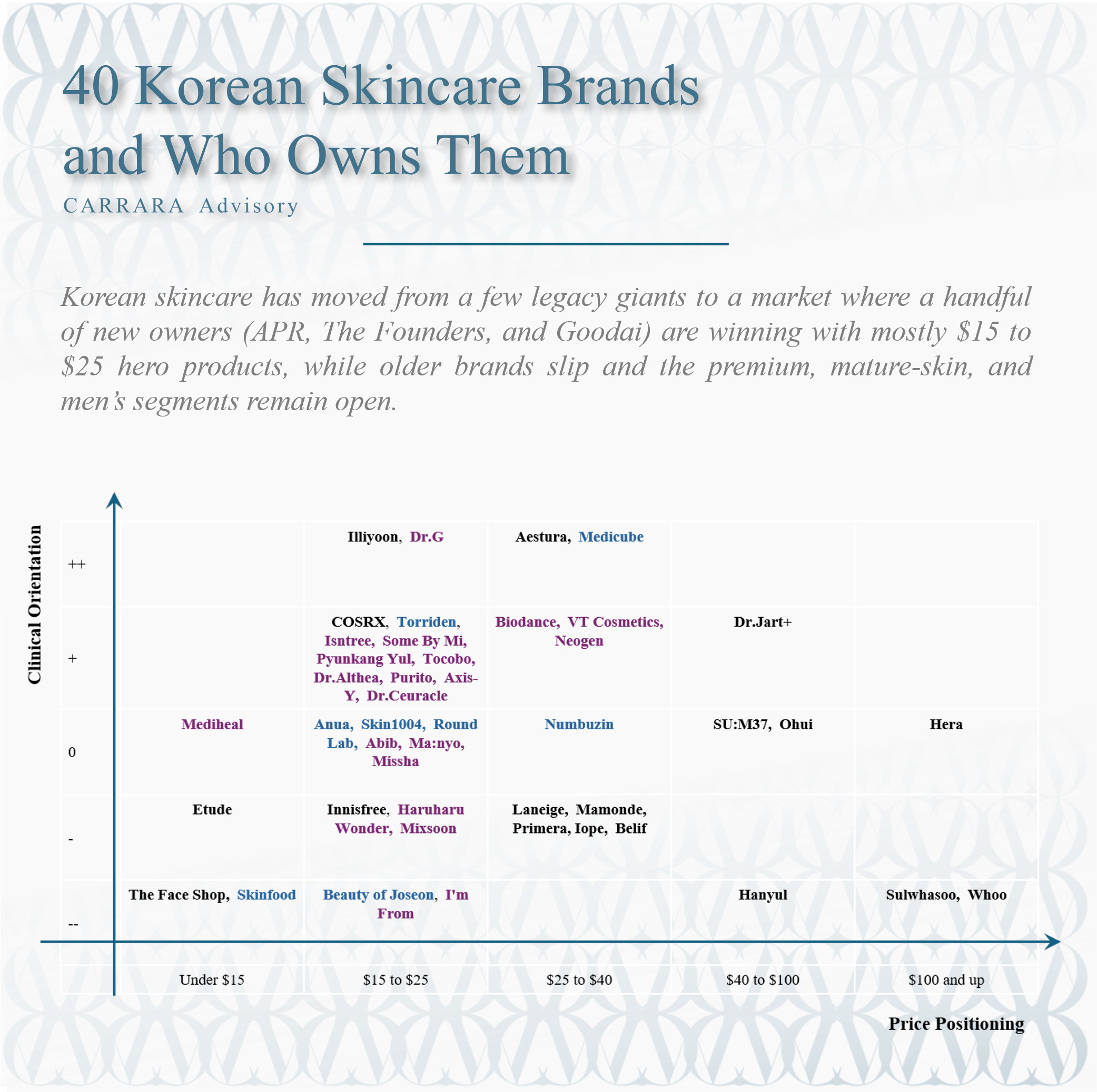
A map of 40 brands by owner, size, price, and channel, and what it says about winners, losers, and gaps.
Korean cosmetics exports hit a record $11.4 billion in 2025, which pushed Korea past the United States into second place worldwide, behind France. Skincare drives that number. Basic skincare accounted for $8.5 billion, or 74.7% of all cosmetics exports. The United States became the top destination for the first time, with shipments up 15% to $2.2 billion, while China fell 19% to $2 billion.
Behind those totals sits a business that looks very different from the one most shoppers picture. The brands people talk about are not all run by the same kind of company. Some belong to century old conglomerates, some to a new class of acquisitive holding companies, some to a single founder, and one famous name belongs to an American cosmetics group that has spent years trying to make sense of it. Underneath all of them is a layer of contract manufacturers and distributors that most consumers never hear about but that shapes who can launch and who can scale.
This piece maps roughly 40 skincare brands by owner, size, categories, price, channels, and audience. Then it asks where the market is crowded, where it is empty, and who is gaining or losing ground.
How to read the numbers
Most Korean brands do not publish brand level revenue. Where a figure is reported by a company or a reputable trade outlet, the tables say so. Where it is not, the tables give an estimate band based on group revenue, disclosed brand shares, and retail footprint. Treat those bands as informed judgment, not audited data.
Price tiers are based on the typical U.S. list price of each brand's hero product, before discounts: under $15, $15 to $25, $25 to $40, $40 to $100, and $100 and up. Cross border discount sites often list the same products far below these levels, so they are a poor guide to positioning.
The three ownership models
1. The conglomerates
Two groups built modern K-beauty: Amorepacific and LG Household & Health Care. They still own the largest number of well known brands and the deepest department store and duty free relationships.
Amorepacific Group reported consolidated 2025 revenue of KRW 4.62 trillion and operating profit of KRW 368 billion, its highest operating profit in six years. Overseas is where the improvement came from. Overseas revenue rose 15% and overseas operating profit doubled. The Americas grew 20% and EMEA grew 42%. Its skincare brands run from luxury (Sulwhasoo, Hera) through premium (Laneige, Aestura, Primera, Iope, Mamonde) to accessible and derma (Illiyoon, Innisfree, Etude) plus COSRX, the independent it bought its way into.
LG H&H runs a parallel ladder with The History of Whoo and SU:M37 at the top, Belif and Ohui in the middle, and The Face Shop at the mass end. Its recent results are weaker. In the second quarter of 2025 its beauty division saw sales fall 19.4% to KRW 604.6 billion and swung to an operating loss of KRW 16.3 billion. Its most exciting growth came from hair care, where Dr.Groot saw sales in North America surge 800% in the first half, driven by Amazon and TikTok. That is a good result for LG and a telling one for skincare.
2. The aggregators
The most important shift of the past three years is the rise of holding companies that buy or build many indie brands and run them through one commercial machine.
Goodai Global is the clearest case. It started as an ordinary manufacturer and distributor and changed direction in 2019 when it bought Beauty of Joseon. It later added Tirtir, Skin1004 through Craver, and Seorin, which operates Round Lab, plus House of Hur and the veteran brand Skinfood. Reported 2025 consolidated revenue was about KRW 1.47 trillion, with operating profit of KRW 273.4 billion. In February 2026 it also bought a U.S. distributor, Hansung USA, for about KRW 100 billion, which supplies retailers including Costco and Target. In July 2026 it signed an MOU with Torriden to pursue a minority strategic investment, with Torriden keeping independent management. Reports suggest Goodai may be preparing a stock market listing.
Benow is the smaller cousin. It operates Numbuzin, Fwee, Knock, Flaskin, and Riah. It reported 2025 revenue of KRW 266.4 billion and net income of KRW 75.1 billion, which is a very high margin for a consumer goods company.
3. The single brand powerhouses
Two companies have grown to large scale mostly on one flagship brand each.
APR, owner of Medicube, is the biggest example. Its consolidated 2025 revenue reached KRW 1.5273 trillion, up 111.3%. Overseas markets made up 80% of group sales. In November 2025 it passed a market value of KRW 10 trillion and overtook Amorepacific as Korea's most valuable beauty company, and by mid July 2026 its value had reached KRW 14.04 trillion.
The Founders, the company behind Anua, is the second. Revenue rose from KRW 57.6 billion in 2022 to KRW 427.7 billion in 2024 and then KRW 717.7 billion in 2025, with operating profit of KRW 129.5 billion last year. Overseas sales account for more than 90% of its revenue.
The invisible layer
Two groups sit under and around everyone else.
The first is contract manufacturers. Cosmax led Korea's ODM ranking with KRW 1.6 trillion, followed by Kolmar Korea at KRW 1.3 trillion and Cosmecca Korea at KRW 353.1 billion. Cosmax alone produces for APR, Anua, and Biodance. This matters for the map because many rival brands share the same formulation labs. A small founder team can launch a credible serum without owning a factory, which is one reason the market is so crowded at the entry level.
The second is distributors and retail platforms. Silicon2, a global distributor, reported record first quarter 2025 consolidated sales of KRW 245.7 billion and lists Medicube, Biodance, Beauty of Joseon, Skin1004, Isntree, Mixsoon, Round Lab, COSRX, and others among its clients. In August 2026, CVC Capital Partners agreed to invest about KRW 300 billion ($220 million) in Silicon2. Investors now see real value in the plumbing of K-beauty, not only in the brands.
Retail matters just as much. Olive Young, Korea's dominant beauty chain, generated about $4.2 billion in annual sales in Korea in 2025 and operates more than 1,380 stores. It opened its first U.S. store in Pasadena, and in January 2026 it announced a partnership with Sephora.
Legacy and conglomerate brands

Table 1: Legacy and conglomerate brands
COSRX was bought at a valuation the sellers were very happy with. Amorepacific paid KRW 755.1 billion for the remaining shares, after taking 38.4% in 2021, to reach 93.2% ownership. At the time, North America made up about 48% of its revenue. Its 2025 was messier, which comes up below.
Challengers and independents

Table 2: Challengers and independents
The size bands for the independents come from retail footprint and distributor disclosures, not filings. The retail facts are better documented. Ulta added VT Cosmetics, I'm From, Some By Mi, Mixsoon, Sungboon, Neogen, Chasin Rabbits and Medicube in 2025, after bringing in Anua, Etude, Isntree, and Round Lab earlier in the year. Target carries Mediheal, Round Lab, Skin1004, Ma:nyo, Torriden and Beauty of Joseon, and added Numbuzin.
Positioning map: price against clinical orientation
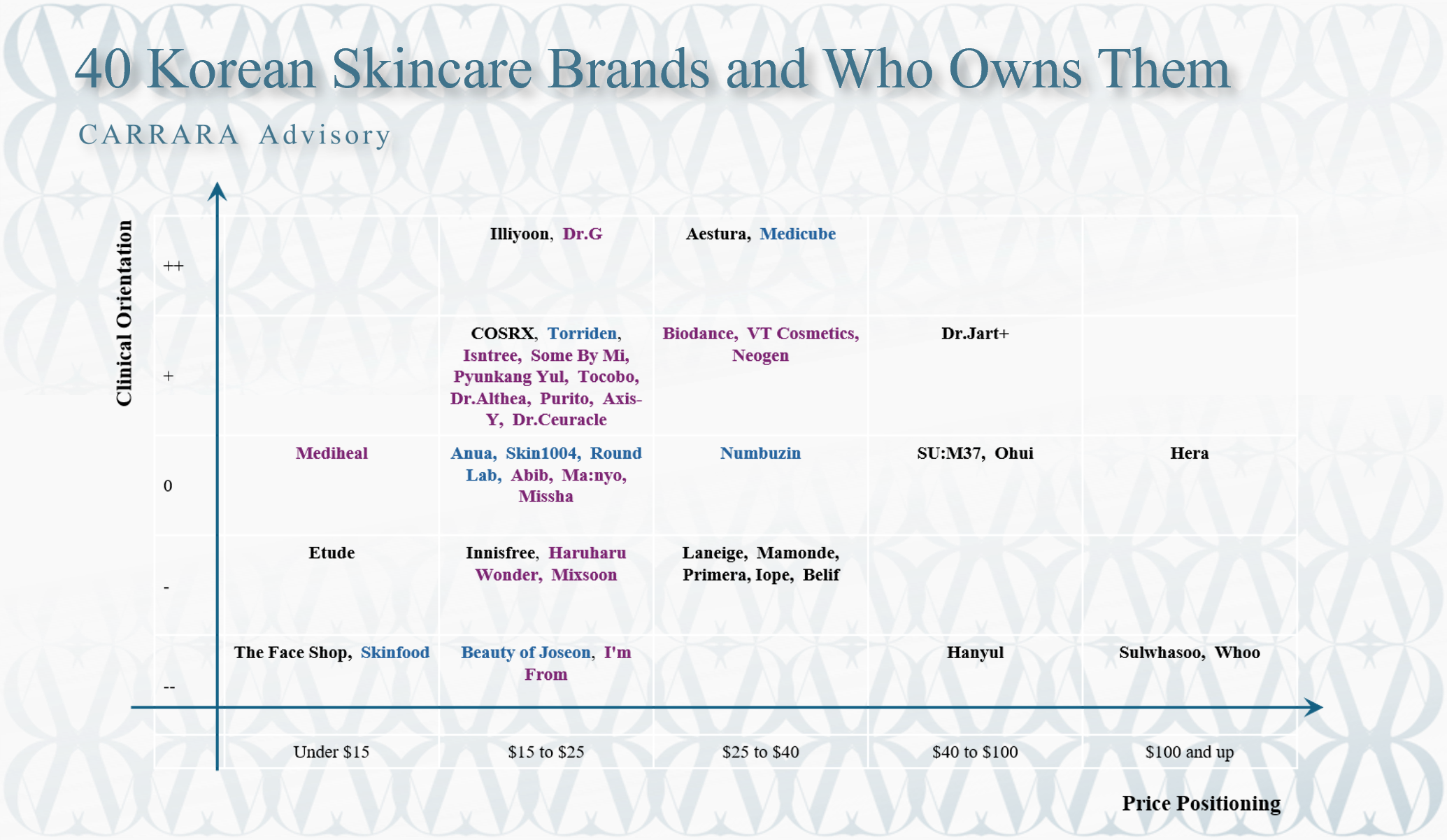
Each brand is placed by the typical U.S. list price of its hero product (horizontal axis) and by how clinical its positioning is (vertical axis, scored from minus two to plus two). Clinical orientation runs from botanical or heritage claims at the bottom to derma and device based claims at the top. Brand names are colored by owner type: black bold for conglomerate owned brands, blue bold for scaled challengers (Medicube, Anua, and the Goodai and Benow brands), and purple for independents and smaller brands.
How solid the placements are
Price tiers rest on checked U.S. list prices for Beauty of Joseon, Anua, COSRX, Aestura, Isntree, Round Lab, Some By Mi, and Pyunkang Yul, and on U.K. and European list prices for Laneige and Medicube. Placements for the other brands are estimates from typical price ranges. Clinical orientation scores are editorial judgment based on each brand's positioning and claims. Brands whose range straddles two tiers (Laneige, Aestura, COSRX) could reasonably sit one cell over.
What the map shows: the $15 to $25 column is the market's center. In this sample, the $40 to $100 column holds only established brands, and Dr.Jart+ is the only brand in the cell for premium price with strong clinical positioning. Luxury is entirely heritage led. The brands that are growing fastest sit at $15 to $40.
What the map says: price and audience
Sorting all of this by price shows a market that is less cheap than its reputation. Verified list prices for the best known hero products cluster between $15 and $25: Beauty of Joseon's Relief Sun lists at about $18, Anua's Heartleaf toner at about $23, and COSRX's snail mucin essence at about $25. Very little of the core range sits under $15.
The $15 to $25 tier is the busiest. Beauty of Joseon, Anua, COSRX, Skin1004, Round Lab, Torriden, Isntree, Some By Mi, and Pyunkang Yul all live here, along with most of the long tail of independents. The buyer skews young, female, and digital, and leans on ingredient claims, short video, and e-commerce. Brand level audience data is thin, so read this as a pattern, not a measurement. The competitive question is who can hold a hero product for more than one season.
Under $15 is a small group. It holds Mediheal's sheet masks, plus Etude, The Face Shop, Skinfood, and a handful of cleansers and entry products. This is the real mass tier, and it is mostly owned by legacy brands.
The $25 to $40 tier is where the strongest growth stories are heading. Medicube, Numbuzin, Biodance, Laneige, and Aestura sit here. Buyers are slightly older, slightly more affluent, and more willing to buy a full routine from one brand.
In this sample, the $40 to $100 tier is held by established brands: Hanyul, SU:M37, Ohui, and Dr.Jart+. No scaled challenger has entered it, which makes it the clearest open space on the map. The $100 and up tier belongs almost entirely to Sulwhasoo, Hera, and Whoo, and their buyers are older and skew Korean and Chinese.
Audience follows price. Under 35 is well served. Few brands in the sample speak to mature skin at accessible or premium prices, and the luxury brands that serve older buyers sell mostly in Asia. Men are barely present. Teens are present in volume but in a low margin way.
What the map says: categories
The category map is more concentrated than the brand count suggests.
Sun care is one of the clearest success stories. Euromonitor named Beauty of Joseon the top K-beauty suncare brand in global online sales. Skin1004 and Isntree have pushed into the same territory with lighter textures.
Toners and essences are the entry point for Anua, Numbuzin, Round Lab, and Isntree. Hydration serums belong to Torriden. Acne and repair belong to COSRX and Some By Mi. Cleansing oils and balms are the specialty of Anua and Ma:nyo.
Masks are the territory of Mediheal at the low end and Biodance at a higher price with its overnight hydrogel format. Biodance became the top selling item in Amazon's beauty and personal care category over Black Friday and Cyber Monday.
Devices are Medicube's own category. Its AGE-R line, led by the Booster Pro, passed 5 million units sold worldwide by September 2025. APR reported about KRW 407 billion in device revenue for 2025 out of KRW 1.527 trillion in group revenue. The share is moving. Devices were about 27% of third quarter revenue (KRW 103.1 billion of KRW 385.9 billion) and 22.4% in the fourth quarter, down from 42.3% a year earlier, because cosmetics grew faster. No other brand in this map reports a device business of comparable size, and the pairing of devices with refills and serums is hard to copy.
Derma or clinical positioning belongs to Aestura and Illiyoon, both Amorepacific, plus Dr.G. Lip care, essentially, belongs to Laneige. Anti aging with ginseng and herbal heritage belongs to Sulwhasoo, Whoo, and Hanyul.
What the map says: channels and geography
The channel story has flipped in five years. Legacy brands were built on own store networks, department stores, and duty free. Challengers were built on Amazon, TikTok Shop, and direct websites, and are now buying their way into physical shelves.
Numbers on this are noisy. One consultant's estimate has online distribution at more than 45% of K-beauty sales. A more careful data point is the mid 2025 read from Spate and NielsenIQ, which put U.S. K-beauty sales at $2 billion for the twelve months to early August, up 37% year over year, with facial skincare leading. A separate market research house puts the 2025 U.S. K-beauty skincare market at $3.1 billion, though that firm's numbers should be treated as an estimate. The same firm names COSRX, Laneige, Beauty of Joseon, Medicube, and Anua as the leading brands in the U.S., a list that matches most other sources.
Anua shows how quickly online turns into offline. In the U.K., its launch on the Boots website produced a 240% sales jump in its second week, and it later expanded from 120 stores to 470 Boots locations. Beauty of Joseon is now in more than 2,000 U.K. stores across Boots, Superdrug, Marks & Spencer and Space NK.
Geography is shifting as well. China used to be the automatic growth market. It is now a place of caution: exports there fell 19% in 2025, and Amorepacific said its Greater China business returned to profitability only after structural improvements. The U.S. is now the largest destination. Japan is strong, with Medicube reporting Japan revenue up 100.8% in the first quarter of 2026. Europe and Southeast Asia are moving quickly: APR reported that its combined Europe and Southeast Asia revenue grew nearly fourfold in 2025. Newer growth pockets include Poland and the UAE, where exports rose 121% and 74% respectively in the first five months of 2025. Korean brands are also entering Australia and India.
The base underneath all this is broad. Small and mid sized companies produced 72.5% of Korean cosmetics exports in 2025, up from 63.6% in 2023. The number of destination countries rose from 172 to 202 in a single year.
The winners
APR and Medicube are the clearest winners on growth and market value. They found a category, devices, that the rest of the market had not touched, and they paired it with formulas, so a customer buys a $200 gadget and then reorders pads and serums. Their exposure is that one product family carries a lot of the revenue, and devices carry regulatory and copycat risk.
The Founders and Anua built the fastest growing pure skincare company in the market on a few hero items and very fast content response. Revenue grew from KRW 57.6 billion in 2022 to KRW 717.7 billion in 2025, with an operating margin near 18%. The company was reported to be exploring a bid for Dr.Jart+ from Estée Lauder, which would be a startling reversal of who buys whom.
Goodai Global is the winner on structure. Nobody else owns as many meaningful brands with as much control over distribution. Private equity investors reportedly valued the company at $3.1 billion. The strategic logic is a portfolio that covers sun care, toners, centella, color, and basics, so a retailer such as Target or Sephora can call one supplier.
Benow is a quiet winner. Numbuzin is a mid priced brand with a systematic numbering approach, and its parent's margins suggest excellent cost control.
Laneige and Aestura within Amorepacific show that a legacy owner can still win. Amorepacific said its Americas growth was supported by strong Laneige lip and skincare demand and by launches of Aestura and Hanyul. Laneige is the rare brand that is premium priced and still mainstream.
Biodance, Torriden, Skin1004, and Mediheal are winning at different scales. They are large enough to matter and still small enough to attract buyers, as Goodai's move on Torriden shows. Korean press has named L&P Cosmetic (Mediheal) and Torriden among likely stock market candidates.
The platforms and factories are winners no matter which brand wins the month. Olive Young, Silicon2, Cosmax, and Kolmar take a slice of nearly every success.
The losers
Dr.Jart+ is the standout casualty. Estée Lauder recorded a $375 million impairment on the brand's intangible assets, citing weaker than expected results in Korea and mainland China. It then explored a sale and decided in July 2026 to keep the brand. Estée Lauder does not report Dr.Jart+ revenue separately, and press estimates put 2025 sales near $150 million. The brand sat in the premium middle, between accessible indies and luxury, the tier this map shows to be thinly served.
LG H&H's beauty division is losing ground. The drop in sales and the loss described earlier come with a portfolio that leans on older luxury and mid tier brands with a heavy China dependency. Its best momentum sits in hair care, not skincare.
Legacy retail led brands such as The Face Shop and Etude have been forced to rethink their store networks. Innisfree is a partial recovery story. In 2024 its sales fell 18% and operating profit fell 84%, then in 2025 revenue slipped another 7% while operating profit rose sharply to KRW 13.3 billion after a channel portfolio restructuring. That is a company that shrank into profitability and lost its status as a growth engine.
COSRX stumbled in 2025 despite its dominance in the ingredient led category. Amorepacific said COSRX restructured its distribution network and returned to revenue growth only in the fourth quarter, led by a newly developed peptide line. Buying a viral indie is expensive, and keeping it viral is harder.
China facing luxury is in a holding pattern. Sulwhasoo and Whoo still make large money, but the growth is elsewhere.
The gaps
Reading the map from the empty spaces, several openings stand out.
1. The premium middle. In this sample, the $40 to $100 tier belongs to established brands, with no scaled digital challenger. That looks like an opening for a differentiated premium K-beauty brand, though pricing power and demand are unproven and Dr.Jart+'s struggles show the tier is hard.
2. Clinical luxury. Nobody pairs real derma credentials with a $100 and up price. Luxury is all heritage and ginseng, and clinical brands stop at about $40.
3. Mature skin. Nearly all challenger energy targets buyers under 35. Peptide and collagen lines are the beginning of an answer, and COSRX's peptide line and Biodance's collagen positioning point this way. There is still no clear Western facing K-beauty leader for women over 50 at a mid price.
4. Men. Men's skincare is thin among the internationally scaled brands in this sample. Whether demand is large enough to build on is untested.
5. Clinical evidence. Many brands claim science, but few publish clinical data at scale. Aestura and Illiyoon have the derma credentials, and a truly independent derma brand with strong evidence could take a real share.
6. Deeper skin tones and diverse skin needs. Sun care and complexion products have not been developed with the same rigor for every skin tone. Regulatory differences on sunscreen filters between Korea and the U.S. also limit which products travel unchanged.
7. Body, scalp, and hair. Hair is growing fast. Dr.Groot's numbers and the data from Spate that showed hair care as the fastest growing K-beauty area in the U.S. both suggest scalp care is the next category. Body skincare remains underdeveloped.
8. Geography. Latin America, India, and Africa remain lightly served. The Middle East and Eastern Europe are the current growth markets and are not yet dominated by any one player.
9. Physical retail control. Many brands still rely on Amazon and TikTok Shop for the bulk of their revenue. Owning the store relationship, as Goodai now does with its U.S. distributor, will separate the durable from the fashionable.
10. Supply concentration. A small number of ODMs make products for many rival brands, which lowers the barrier to launching and thins differentiation. A brand that owns its formulas and holds exclusivity would stand apart.
What to watch next
Four developments will decide the next round.
First, listings. Goodai Global, Benow, Torriden, and L&P Cosmetic are the names Korean press links to future stock market activity. No timetable is confirmed, but a wave of listings would force disclosure, and the estimated bands in this article would become hard numbers.
Second, consolidation. With Goodai buying, The Founders shopping, and Amorepacific still active, expect more indie brands to be absorbed. The likely targets are the $100 million to $250 million brands with a strong hero product but limited distribution.
Third, retail. Olive Young's U.S. rollout and its Sephora partnership will test whether Korean brands can win under a Korean retail concept overseas, or whether Western retailers keep control of the shelf.
Fourth, hero product fatigue. Nearly every winner here is built on a small number of items: a sunscreen, a toner, a booster device, a mask. The brands that broaden their range without losing that focus will be the survivors of the next cycle.
The overall picture is one of a market that has been rebuilt. Twenty years ago, the map would have been two conglomerates and a few department store names. Today it is a set of conglomerates in repair mode, a group of aggregators building their own versions of L'Oréal, one device company that changed the price ladder, and a long tail of independents waiting to be acquired or squeezed. The gaps sit in the middle of the price range, in older skin, and on the physical shelf.
Notes and sources
Size bands marked as estimates are inferred from group revenue and retail footprint, so check any figure you plan to headline. Owner details for the smaller independents (founder led) reflect the absence of a known parent, not a confirmed ownership check. Some market share figures come from commercial research houses of uneven quality and are flagged in the text. Before publication, check four items against primary documents: the terms of CVC's investment in Silicon2, APR's device revenue figure of about KRW 407 billion, the amount and fiscal year of Estée Lauder's Dr.Jart+ impairment, and the Torriden MOU terms.
• Korean cosmetics export totals and destinations: Global Cosmetics News, Korea JoongAng Daily, Korea Biomedical Review (2026).
• Amorepacific results: Amorepacific Group 2025 earnings summary (apgroup.com), Asia Economy, Personal Care Insights; 2024 results summary (apgroup.com).
• LG H&H: Cosmetics Design Asia, Korea Biomedical Review, TradingView summary of Q2 2025 results.
• APR, The Founders, Goodai, Benow: Asia Business Daily, Seoulz, KED Global, Wikipedia entries for Benow, Glossy (Medicube profiles), WWD Top 100 coverage.
• Dr.Jart+: Jing Daily, WWD, Business of Fashion, Cosmetics Business, Estée Lauder SEC filings.
• APR quarterly results and device sales: Cosmetics Design Asia (third quarter 2025), Korea JoongAng Daily (fourth quarter and full year 2025).
• COSRX acquisition: Retail Dive, Mirae Asset research note.
• Retail: WWD and Beauty Matter on Olive Young U.S. expansion, Glossy on Ulta and Target brand additions, Qogita retailer guide.
• Distribution: Silicon2 IR book (first quarter 2025), Mergermarket coverage of K-beauty deals.
Hero product list prices: ShopBack brand comparison (2026), Mirai Skin price guide, Cult Beauty and Beyond RX
