
EXECUTIVE SUMMARY
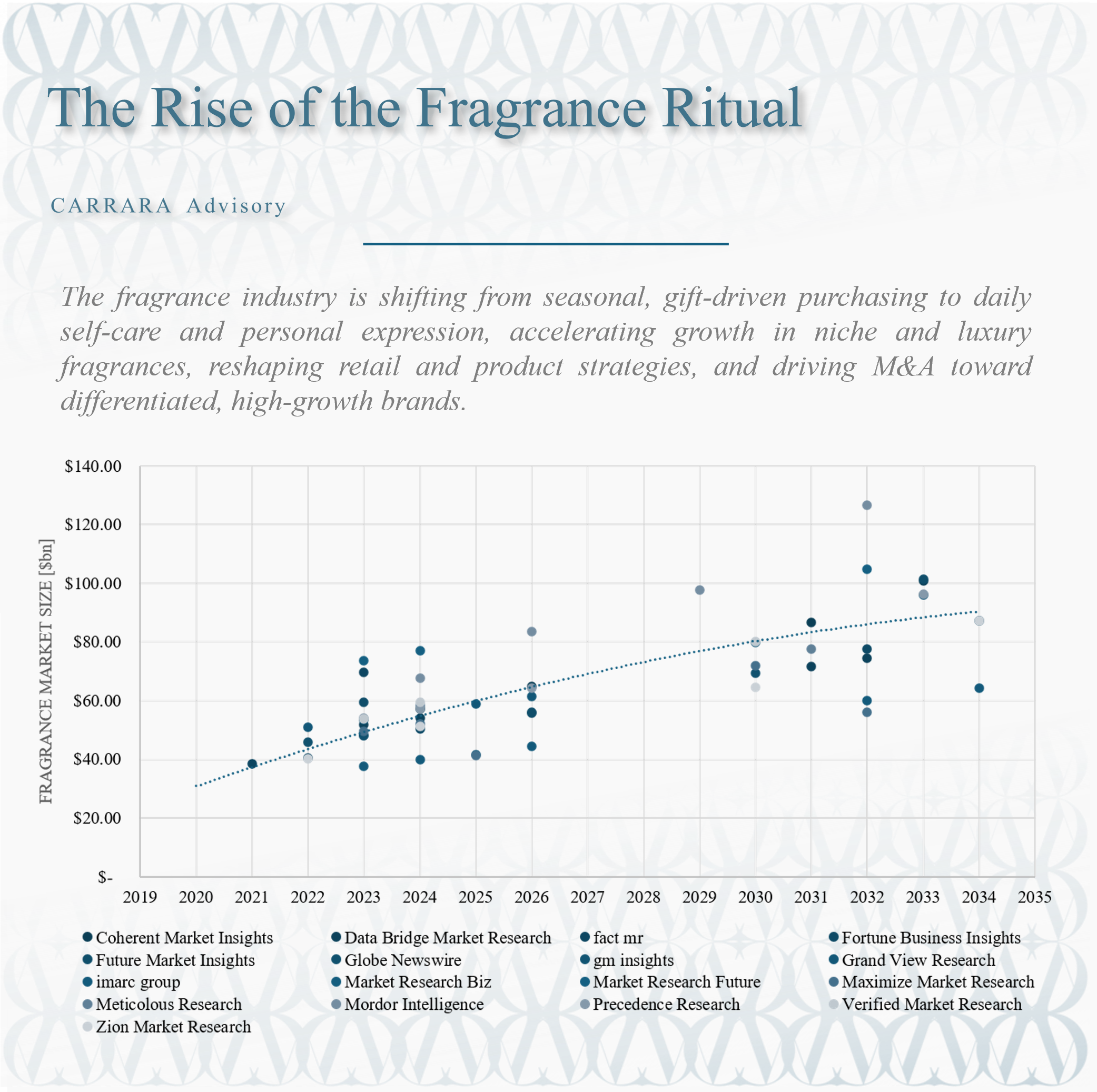
The global fragrance industry is experiencing a structural realignment. For many years, the market operated on a cyclical rhythm tethered to seasonal gifting. This model prioritized gift-giving as the primary engine for revenue, which placed the industry at the mercy of holiday calendars and anniversary milestones. Our analysis indicates a fundamental transition. Consumers now treat fragrance as a consistent personal wellness requirement rather than an occasional luxury purchase. This evolution mirrors shifts in other beauty sectors where self-care routines command daily engagement.
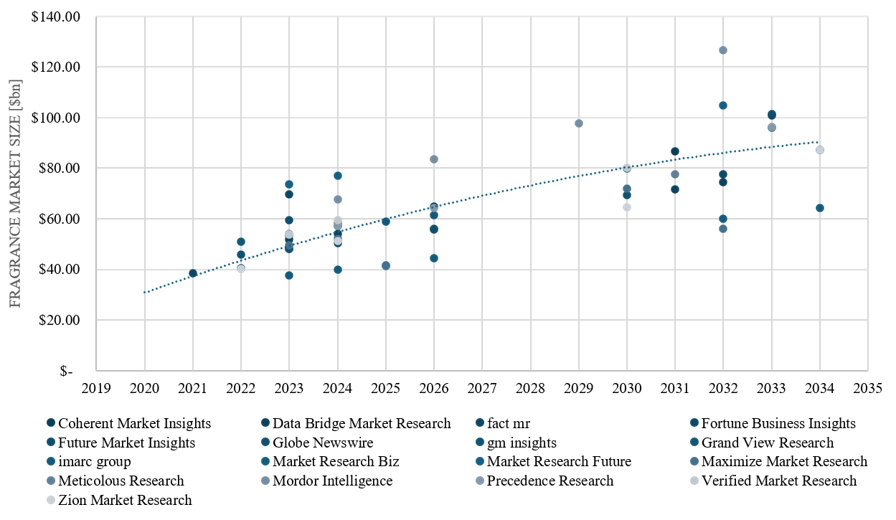
As individuals seek scent for identity expression and mood modulation, the purchase frequency of luxury fragrance has solidified. While the specific percentage of consumers who classify fragrance as a self-treat remains, the shift in behavioral patterns is evident across primary growth segments. Brands must now adapt their operations to support recurring daily engagement. Our analysis indicates that companies failing to align their product offerings with this personal ritual mindset will struggle to capture the projected growth of the global market, which estimates suggest will reach around US$64.3 billion by 2026 (Source: average of 17 research firms’ extrapolation).
THE FRAGRANCE MARKET IN FLUX
The global fragrance market is currently undergoing a period of intense structural reorganization. We observe that the total market value is projected to reach around US$64.3 billion by 2026 (Source: average of 17 research firms’ extrapolation). This headline figure masks a significant divergence in performance across different segments of the industry. The primary driver of this disparity is the decoupling of growth rates between mass-market offerings and the specialized niche and luxury sectors.
We identify a clear distinction in long-term momentum. The niche fragrance segment is expanding at a compound annual growth rate of 13.2%, while the broader premium and luxury category is expanding at an annual rate of 8% to 10.4% (Source: Scento, 2026-02-04; Mordor Intelligence, 2026). In contrast, mass-market fragrance growth is estimated at approximately 4% to 5.1% annually (Source: Couponzania, 2026-09-13; Comredix, 2026-11-13). This divergence suggests that consumers are migrating away from standardized, high-volume products toward offerings that emphasize scarcity, craftsmanship, and artisanal value.
It is important to distinguish between short-term volume surges and sustainable long-term value creation. We must clarify the recent performance data regarding the mass market. While United States mass retail saw a 15% growth in 2025 (Source: Comredix, 2026-11-13), this represents a specific anomaly in volume within the mass channel, which typically operates at the lower annual growth trajectory of 4% to 5.1%. Meanwhile, the prestige sector exhibits different mechanics. United States prestige fragrance dollar sales grew by approximately 6% in the first half of 2026, though this growth was driven primarily by price increases rather than volume (Source: Comredix, 2026-11-13).
The mechanisms driving these segments are distinct. The niche market benefits from agility and alignment with a consumer base that values olfactory exclusivity. At the Pitti Fragranze 2026 event, which serves as a premier gathering for the artisanal and independent perfume sector, 54% of participating fragrance brands reported a growth rate greater than 5% over the previous year (Source: BeautyMatter, 2026-09-20). This figure highlights the effectiveness of the small-batch production model. In contrast, the mainstream sector faces the challenges of market saturation and the potential dilution of brand equity.
The economic implications for brands are significant. As the niche segment captures a larger share of the market, mainstream players face a period of forced introspection. They must determine whether to continue a volume-based strategy or pivot toward the higher-margin, slower-growth model characteristic of luxury houses. We conclude that the success of the niche sector is not a transient trend but a reflection of a fundamental shift in value perception.
THE NEW FRAGRANCE CONSUMER
The contemporary fragrance consumer displays behaviors that indicate a profound departure from historical purchase patterns. Fragrance is no longer confined to the role of a seasonal gift; it has transitioned into a fundamental component of personal identity and daily wellness. The move toward self-gifting implies a change in the frequency of consumption, as individuals purchase scents for their own satisfaction.
This transition is particularly evident within younger demographics who view olfactory expression as a mechanism for curation. Gen Z consumers exhibit a distinct preference for this approach, with 27% of them favoring niche or bespoke scents over mainstream alternatives (Source: Scento, 2026-02-04). This expectation for personalized experiences has necessitated a broader shift in product development. Brands are responding to this preference for non-gendered identities, as seen in the broader market where 40% of new fragrance launches were classified as unisex in 2024 (Source: Scento, 2026-02-04).
The willingness of consumers to invest in unique formulations further characterizes the new fragrance buyer. We observe that 42% of fragrance buyers are now willing to pay a premium for unique formulations (Source: Scento, 2026-02-04). This behavior is not limited to a small segment of the market, although the specific percentage of total consumers who have purchased a luxury fragrance in the recent past remains.
The psychological driver behind these trends is the intersection of fragrance with personal care. As consumers integrate scent into daily routines, they look for products that offer a narrative or specific mood enhancement. While the market remains sensitive to price points, given that a significant portion of users remain price-conscious, the demand for uniqueness suggests that the value perception is shifting toward quality and personal alignment.
In an era where personal branding is a standard social practice, the olfactory signature acts as a definitive marker of identity. The combination of increased self-gifting and the prioritization of unique scents creates pressure on fragrance houses to rethink their product pipelines. The challenge is to reconcile the demand for premium, bespoke experiences with the reality that a portion of the market operates within lower spending thresholds. Companies that provide narratives of exclusivity while maintaining accessibility will likely capture a larger share of the evolving consumer interest.
THE NICHE PHENOMENON
The current performance of the fragrance market reveals a distinct separation between established luxury houses and the surging independent, niche sector. Our analysis indicates that the niche fragrance segment is expanding at a compound annual growth rate of 13.2% (Source: Scento, 2026-02-04). Meanwhile, the broader premium and luxury category is expanding at an annual rate of 8% to 10.4% (Source: Mordor Intelligence, 2026). These figures demonstrate a persistent appetite for high-end, differentiated products that is currently outpacing the mass market.
Evidence of this momentum is visible in the performance metrics of independent perfumeries. At the Pitti Fragranze 2026 event, 54% of participating fragrance brands reported growth exceeding 5% compared to the previous year (Source: BeautyMatter, 2026-09-20). Such figures reflect a broader market shift where the cachet of scarcity and unique craftsmanship is rewarded by the modern consumer.
The mechanism driving this success is rooted in the consumer desire for individuation. As olfactory preferences become more granular, buyers seek products that reflect personal identity rather than mass-market appeal. We observe that 42% of fragrance buyers are now willing to pay a premium for unique formulations (Source: Scento, 2026-02-04). This willingness to pay reflects a move away from the standardized scent profiles that characterize the mainstream designer market.
Second-order effects of this trend are creating competitive pressures for traditional luxury conglomerates. The market is witnessing a notable departure from historical gender-coded marketing strategies. By 2024, 40% of new fragrance launches were categorized as unisex (Source: Scento, 2026-02-04). This pivot is a direct response to the preferences of younger cohorts. Notably, 27% of Gen Z consumers now actively favor niche or bespoke scents over traditional offerings (Source: Scento, 2026-02-04).
The implications for brands are clear. The traditional model of relying on established brand names is losing effectiveness against competitors that offer authentic storytelling and scent exclusivity. While mass-market fragrance sales showed significant volume growth in the first half of 2026 (Source: Comredix, 2026-11-13), the value-creation opportunity resides within the niche and premium categories. Brands that fail to adjust their formulations to align with the demand for unique, non-gendered, and artisanal compositions risk long-term stagnation. As we look at the composition of the market, the sustained high-growth rates of niche players indicate that this is not a temporary trend but a fundamental recalibration of the perfume industry.
CHANNEL DYNAMICS AND THE TRIAL PARADOX
The distribution of fragrance remains constrained by a persistent tension between digital convenience and the requirement for physical interaction. Consumers demonstrate that the olfactory experience cannot be adequately replicated through screen-based interfaces. Evidence suggests that a vast majority of consumers prefer to test fragrances in-store. This strong preference creates a friction point for brands attempting to scale purely through online direct-to-consumer models, as data regarding the percentage of fragrance buyers who find online purchase without trial to be a risky endeavor remains.
The reliance on physical channels creates a dependency on traditional retail environments. This suggests that despite the growth of niche brands, the infrastructure of the department store remains a critical acquisition funnel. However, the mechanism of discovery is changing. While many fragrance users discover scents by sampling in-store, brands must determine how to balance the high costs of physical retail presence against the requirement for sensory engagement.
The industry observes a secondary effect of this trial paradox: the expansion of sampling as a surrogate for full-size retail. As consumers seek unique formulations, the demand for testing platforms increases. Consequently, the growth rate of direct-to-consumer subscription sampling has reached 16.2% (Source: Scento, 2026-02-04). This represents an attempt to bridge the gap between the risk-averse consumer and the difficulty of in-store visitation.
Retailers that fail to provide an immersive sensory environment face potential alienation of their customer base. Given that the preference for in-store testing remains high, the physical store operates not merely as a point of sale, but as a mandatory component of the customer journey. When brands rely solely on digital platforms, they often struggle to move consumers past the initial consideration phase.
The trial paradox also influences pricing strategies. There is a disconnect between the premium nature of modern niche offerings and the prevailing price points of the broader consumer base. Retailers that can facilitate the transition from sampling to purchase will likely capture the highest volume. The future of fragrance retail depends on the ability to reconcile the necessity of physical discovery with the operational realities of a cost-effective, high-touch distribution network.
THE ANCILLARY PRODUCT ECOSYSTEM
The fragrance sector experiences a shift in utility, transitioning from a sporadic gifting occasion to a persistent component of daily wellness rituals. This evolution is driven by the expansion of ancillary product lines, such as body oils and lotions, which serve as mechanisms to increase consumption frequency. By integrating scent into secondary skin-care categories, brands effectively lengthen the lifespan of the consumer interaction with their olfactory identity.
The impetus for this expansion lies in the consumer desire for personalization and the extension of scent beyond traditional application points. While precise market growth figures for body oils and lotions as a sub-category of fragrance ancillaries remain, the behavioral shift is manifest. Consumers who view fragrance as a self-treat purchase are increasingly likely to invest in complementary items that offer an immersive sensory experience. This ritualistic approach allows for the layering of scent, thereby increasing the total volume of product consumed per individual.
A primary consequence of this ancillary growth is the normalization of higher price point engagement for everyday use. The shift toward daily rituals creates a bridge between mass-market affordability and prestige-level engagement. When a consumer adopts a body lotion that mirrors their preferred perfume, the barrier to entry for luxury brands lowers, as the ancillary product acts as a high-frequency touchpoint within an established brand portfolio.
The mechanisms of this transformation are rooted in the second-order effects of consumer wellness trends. As scent becomes synonymous with self-care, the frequency of application shifts from event-based usage to daily maintenance. This requires products that offer functionality beyond simple fragrance projection. The correlation between the 13.2% growth rate of the niche fragrance sector (Source: Scento, 2026-02-04) and the rising popularity of scent-led body care indicates that high-end brands are no longer competing solely on the strength of their perfume, but on their capacity to curate a comprehensive lifestyle experience.
By professionalizing the ancillary category, brands transition the fragrance purchase from a static, transactional event into a continuous, active dialogue with the consumer. This creates a powerful barrier against market volatility, as the habits formed through daily ritualization are significantly more difficult to displace than intermittent perfume purchases.
M&A AND VALUE CHAIN CONSOLIDATION
Corporate activity within the fragrance sector reflects a clear intent to capture the high-growth potential of independent and niche brands. As the market experiences a divergence between mainstream and luxury performance, large fragrance houses are securing competitive advantages through acquisitions and targeted investments. This strategic movement integrates specialized creative capabilities into broader corporate portfolios.
Recent developments demonstrate that major players are prioritizing the acquisition of brand equity and agility. We observe that Puig is in the final negotiation stages to acquire Parfums de Marly from the Artessence Group (Source: WWD, 2026-11-17; Reuters, 2026-10-28). The performance of Parfums de Marly illustrates why such assets are prioritized; the brand recorded retail sales exceeding US$780 million for the fiscal year ending March 2026, marking a 42% year-on-year increase (Source: Cosmetics Business 2026-04-29, 36Kr, 2026-11-19). This acquisition underscores the industry desire to secure brands that align with the high-growth trajectories of the niche sector.
Financial entities and corporate arms are providing the necessary capital for emerging brands to scale. Specific investment details for brands such as Salt & Stone remain, but the broader appetite for labels that align with wellness and self-care is clear. These capital injections are intended to catalyze the expansion of product lines and the optimization of supply chains. By facilitating a wider reach, these investments enable niche brands to transition from cult followings to significant market participants.
The mechanism behind this consolidation is twofold. First, it allows the parent company to diversify its risk profile by shifting focus toward the high-growth potential of the niche fragrance market. Second, it creates a mechanism for cross-pollination. When a large house acquires a smaller, more nimble brand, it gains access to proprietary formulations and consumer data. Given that 42% of fragrance buyers demonstrate a willingness to pay more for unique formulations (Source: Scento, 2026-02-04), these acquisitions provide conglomerates with a direct route to the high-value consumer.
This consolidation addresses the changing requirements of the consumer base. As preferences evolve toward non-gendered olfactory identities, corporate groups are using acquisitions to modernize their legacy brand architectures. By layering these independent brands into existing infrastructure, conglomerates ensure they maintain relevance without fundamentally altering the core identity of the acquired asset. The result is a more concentrated industry structure that balances mass-market scale with the high-margin, high-growth potential of the artisanal segment.
STRATEGIC IMPLICATIONS
The transition of fragrance from a sporadic gift to a daily self-care necessity necessitates a reconfiguration of brand architecture and capital deployment. Operators must pivot from seasonal campaign models toward a perpetual engagement strategy. The competitive imperative is to capture the niche segment, which continues to expand at a CAGR of 13.2% (Source: Scento, 2026-02-04).
We advise brands to prioritize the development of unique, non-gendered olfactory identities to satisfy the 27% of Gen Z consumers who actively seek bespoke scent profiles (Source: Scento, 2026-02-04). This demographic shift is a structural change in demand. Brands that fail to adjust their product development pipelines will face attrition in the prestige sector. Furthermore, the fact that 42% of fragrance buyers are willing to pay a premium for unique formulations (Source: Scento, 2026-02-04) provides clear justification for higher price points, provided the narrative remains rooted in authenticity rather than traditional brand prestige.
Investors should focus on brands capable of balancing digital scale with the physical necessity of trial. Capital expenditure must prioritize high-conversion retail partnerships. To mitigate the risks associated with online purchasing, companies should adopt direct-to-consumer sampling models, which are growing at a rate of 16.2% (Source: Scento, 2026-02-04).
Finally, we emphasize the need for fiscal discipline regarding product price tiers. Brands must ensure that entry-level offerings function effectively as acquisition funnels. Future-proofing requires a dual focus: maintaining a participation in the US$64.3 billion global market projected for 2026 (Source: average of 17 research firms’ extrapolation) while securing high-margin, bespoke fragrance assets that appeal to the discerning, wellness-oriented consumer.
SOURCES
Couponzania (2026-09-13) - https://couponzania.com/global-fragrance-market-size-analysis
BeautyMatter (2026-09-20) - https://beautymatter.com/articles/pitti-fragranze-2026
Comredix (2026-11-13) - https://comredix.com/fragrance-market-statistics
Scento (2026-02) - https://www.scento.com/blog/fragrance-market-statistics-2026-size-growth-consumer-trends
WWD (2026-11-17) - https://wwd.com/beauty-industry-news/fragrance/puig-parfums-de-marly-acquisition-1236849201
Reuters (2026-10-28) - https://www.reuters.com/business/retail-consumer/puig-eyes-parfums-de-marly-acquisition
36Kr (2026-11-19) - https://www.36kr.com/newsflashes/264839201
